Trust Hub · Chapter Three

Why is formulated
this way.

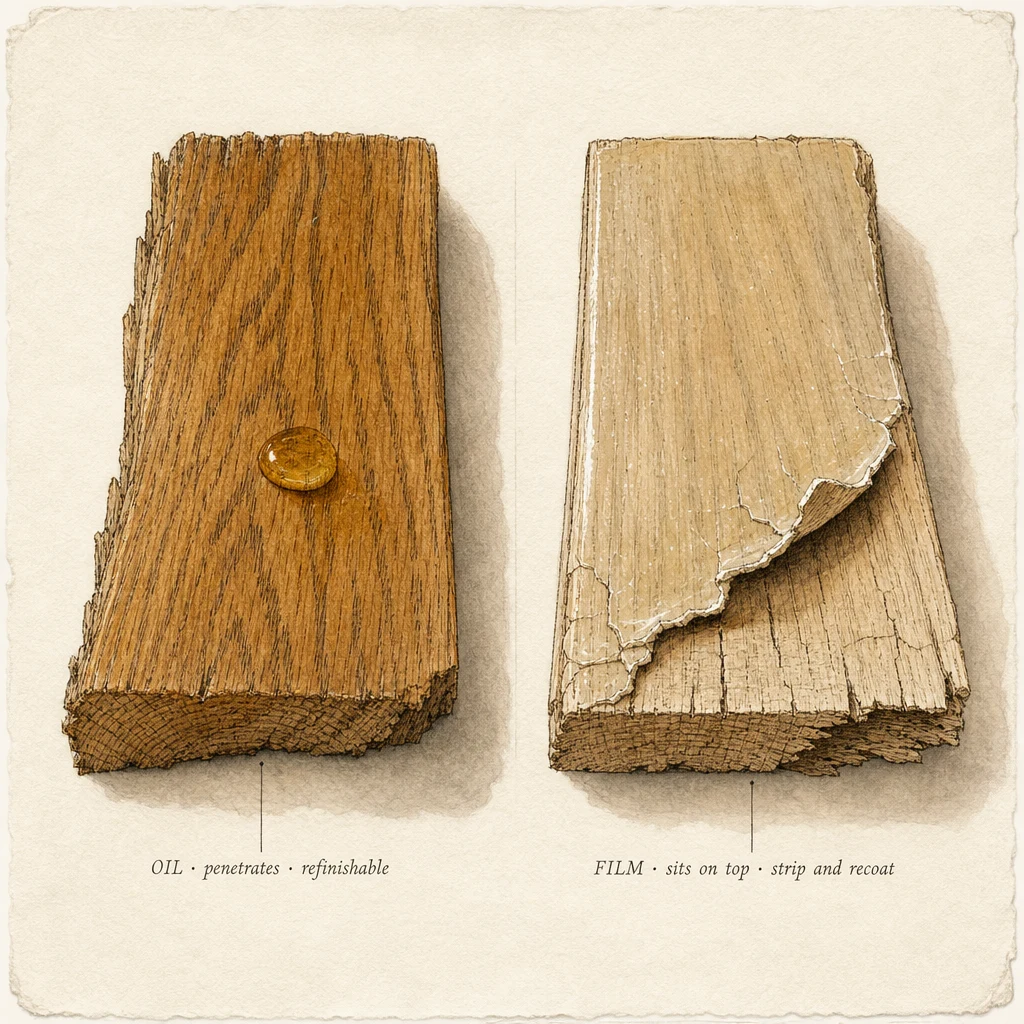
Not "natural is better." The actual film-formation mechanism of each binder family — and what it does and does not promise. Linseed oil polymerises chemically into the wood substrate. Acrylic emulsion fuses as a plastic film on top of it. The EU Commission now names paint as "probably the largest single source of unintentional microplastic release" in the EU at ≈547 000 t/y. This chapter walks the chemistry behind that figure — and behind the reasons LEINOS kept the older binder alive.

Documented, Not Claimed.
Material-register comparison of two oak fragments — one finished with linseed oil, the other with a film-forming synthetic coating.

Method · Four mechanisms behind one word

The word “paint” hides four chemistries.

An architect specifying paint without specifying the binder is specifying a colour and a finish, not a material. Each of the four mechanisms below produces a film with different consequences — for refinishability, vapour permeability, hazard window, and end-of-life behaviour.

Mechanism I

Oxidative polymerisation.

Atmospheric O₂ abstracts bis-allylic C–H bonds on the unsaturated fatty acids of a drying oil; radical chain reactions knit the originally liquid oil into a 3-D cross-linked polymer network (linoxyn). Linseed oil cures this way. Catalysed by metallic driers — never solubilised.

Mechanism II

Solvent evaporation.

A natural polymer (shellac polyester; dammar triterpenoid) is dissolved in a low-MW solvent. The solvent evaporates, leaving a film of the original polymer — no chemical reaction. Fresh solvent re-dissolves the cured film: shellac is fully reversible with ethanol.

Mechanism III

Particle coalescence.

A water dispersion of pre-formed acrylic micro-spheres (≈100–500 nm) dries in three physical stages: water evaporation → particle packing → polymer-chain interdiffusion across particle boundaries above MFFT. No chemical reaction. The polymer was synthesised in a reactor before the can left the factory.

Mechanism IV

Step-growth polyaddition.

An aliphatic polyisocyanate hardener (HDI-isocyanurate trimer) reacts with a polyol on contact to form a urethane crosslink. Two-component, pot-life-limited, irreversible. Densest crosslinked network of any architectural coating — the chemistry behind 2K polyurethane sport floors and museum furniture topcoats.

Inventory · Seven binder chemistries

What is in the can, by mechanism.

Three natural binders LEINOS uses (linseed oil, dammar, shellac) and four synthetic binders LEINOS does not (acrylic emulsion, 2K polyurethane, alkyd, UV-cured acrylate). Each entry is grounded in at least one peer-reviewed chemistry source AND a regulatory or institutional anchor.

Natural · LEINOS uses

  • Linseed oil

    Chemistry
    Bio-derived triglyceride — α-linolenic + linoleic fatty acid esters of glycerol, cold-pressed from flax (Linum usitatissimum).
    Mechanism
    Oxidative polymerisation: radical autoxidation → 3-D cross-linked polymer network (linoxyn). Catalysed by Co / Mn / Zr driers.
    Reversibility
    Operationally reversible — fresh oil re-wets the cured film and re-cross-links into it. Refinishable in place, no stripping.
    LEINOS uses
    Yes — primary LEINOS binder. Oil + oil-wax chemistry across 280 / 290 / 236 / 260.
    Orlova 2021 · Prog. Org. Coatings 151
  • Dammar resin

    Chemistry
    Bio-derived triterpenoid — dammaradienol + hydroxydammarenone, tapped from SE Asian Dipterocarpaceae (Shorea, Hopea, Vateria).
    Mechanism
    Hybrid — physical solvent evaporation followed by slow photo-oxidation over years to decades. Limited cross-linking; no insoluble gel.
    Reversibility
    Re-soluble in polar solvents while fresh; aged films require more polar solvent mixtures.
    LEINOS uses
    Yes — hardness / gloss modifier alongside linseed in oil-resin varnishes.
    Zumbühl 2009 · J. Cult. Heritage 10
  • Shellac

    Chemistry
    Bio-derived, edible polyester — aleuritic + jalaric + shellolic + laksholic acid esters. Refined secretion of lac insect Kerria lacca on Indian and Thai trees.
    Mechanism
    Pure solvent evaporation of ethanol carrier. No polymerisation, no atmospheric O₂ consumed.
    Reversibility
    Fully reversible — fresh ethanol re-dissolves the cured film indefinitely. Conservator's choice for re-coatable French polish.
    LEINOS uses
    Yes — used across the LEINOS formulation set. Food-contact safe (FDA 21 CFR; EU food additive E 904).
    U.S. FDA · 21 CFR shellac inventory

Synthetic · LEINOS does not use

  • Acrylic emulsion

    Chemistry
    Petroleum-derived synthetic copolymer — poly(butyl acrylate-co-MMA) or styrene-acrylic spheres (≈100–500 nm) in water + surfactants + coalescents.
    Mechanism
    Physical particle coalescence above MFFT. Requires coalescing solvent (Texanol®) to plasticise particles at room temperature. No chemical reaction.
    VOC ceiling
    Cat (a) WB matt 30 g/L · Cat (b) WB gloss 100 g/L. "Zero-VOC" labels often via coalescents BP > 250 °C (out of Decopaint scope, outgasses for weeks).
    LEINOS uses
    No. LEINOS does not formulate with acrylic emulsion.
    Keddie 2000 · Materials Sci. Eng. R
  • 2K polyurethane

    Chemistry
    Petroleum-derived 2-component system. Polyol + aliphatic polyisocyanate (HDI-isocyanurate trimer, CAS 28182-81-2 — or IPDI trimer).
    Mechanism
    Chemical step-growth polyaddition — isocyanate + hydroxyl → urethane crosslink. Densest network of any architectural coating. Pot-life-limited.
    VOC ceiling
    Cat (j) WB 140 g/L · Cat (j) SB 500 g/L.
    LEINOS uses
    No. (HDI monomer ECHA-classified Resp. Sens. 1 H334; mandatory diisocyanate-handler training under EU REACH Annex XVII from 24 Aug 2023.)
    ECHA · HDI Substance Infocard
  • Alkyd resin

    Chemistry
    Hybrid petrochemical-and-bio. Polyester backbone (phthalic anhydride from o-xylene) with pendant drying-oil fatty-acid arms (linseed, soya).
    Mechanism
    Hybrid: solvent evaporation + oxidative autoxidation through pendant fatty-acid chains. Accelerated by Co / Mn / Fe driers.
    VOC ceiling
    Cat (d) SB trim 300 g/L · Cat (e) SB varnish 400 g/L · Cat (f) SB woodstain 700 g/L.
    LEINOS uses
    No. (Cobalt 2-ethylhexanoate ECHA-classified Repr. 1B since Nov 2023; phthalic anhydride is Resp. Sens. 1 H334.)
    Weissenborn 2005 · Coord. Chem. Reviews 249
  • UV-cured acrylate

    Chemistry
    Petroleum-derived. Urethane-acrylate / polyester-acrylate oligomers + reactive diluents + photoinitiator.
    Mechanism
    Photo-radical chain crosslinking under UV lamp. Full cure in 1–3 s. Factory-applied only.
    VOC ceiling
    < 5 g/L (100 % solids reactive system). Out of typical Decopaint scope (factory pre-finished panels).
    LEINOS uses
    No. LEINOS does not formulate with UV-cured acrylate.
    Wang 2019 · Polymers 11(9):1414

Method · What each chemistry does

Five binder chemistries, in detail.

Deep Dive · 4.1

Linseed oil — oxidative polymerisation.

Chemistry

A triglyceride drying oil: three unsaturated fatty acid chains (α-linolenic C18:3, linoleic C18:2, oleic C18:1) esterified to glycerol, cold-pressed from Linum usitatissimum flax seed. The high concentration of bis-allylic methylene groups between consecutive C=C double bonds is the chemistry the film-formation mechanism depends on.

Cure mechanism

Atmospheric O₂ abstracts the bis-allylic C–H bonds to give carbon-centred radicals; oxygen adds to form peroxyl radicals; the peroxyl species abstracts another bis-allylic hydrogen to yield a hydroperoxide and propagate the chain — the classic radical autoxidation mechanism RH + O₂ → ROOH. Hydroperoxides decompose into alkoxyl and hydroxyl radicals; termination by coupling forms the actual cross-links that knit the liquid triglyceride into a 3-D polymer network (linoxyn). Metallic driers (cobalt, manganese, zirconium 2-ethylhexanoates) act as homogeneous catalysts — they do not enter the polymer.

Substrate behaviour

Because linseed oil is liquid and low-viscosity, it does not deposit a surface film. It is drawn into the lumens and pit apertures of wood and reacts in situ with cell-wall hydroxyl groups in the lignin / cellulose matrix; FTIR studies on epoxidised linseed oil confirm covalent grafting to wood –OH groups. The cured polymer is mechanically interlocked with the substrate rather than bonded as a film — so abrasion exposes oil-saturated fibre, not bare wood, and a fresh coat re-wets the existing polymer and re-cross-links into it. This is the chemical basis for refinishable maintenance: no stripping required.

Limitations

Linseed oil yellows under UV — pigmented systems perform substantially better than transparent. On direct-sun Indian exteriors the recoat cycle is shorter (~12–24 months) than for UV-stabilised synthetic systems. The trade-off is shorter cycle on a re-oilable system vs longer cycle on a strip-and-recoat system — additive maintenance vs destructive maintenance. The cured network biodegrades in environment-release scenarios via lipase + oxidative microbial pathways → CO₂ + biomass. No microplastic.

Deep Dive · 4.2

Dammar & shellac — two natural-resin mechanisms.

Dammar resin

A triterpenoid plant resin tapped from Southeast Asian Dipterocarpaceae — Shorea, Hopea, Balanocarpus, Vateria. Chemically a mixture of tetracyclic dammarane-skeleton compounds (dammaradienol, hydroxydammarenone, dammarenediol I/II). Film formation is hybrid: physical solvent evaporation leaves a hard transparent film; slow photo-oxidation then proceeds in the dried film over years to decades, introducing polar carboxylic acid groups that eventually yellow and embrittle. Cross-linking is limited; films remain re-soluble in polar solvents. In coatings practice dammar is used as a hardness / gloss modifier alongside drying oils — it raises early film hardness and gloss while remaining compatible with oxidative cure.

Shellac — pure solvent evaporation

The refined resinous secretion of the female lac insect Kerria lacca on host trees in India and Thailand. Chemically a complex polyester macromolecule of long-chain hydroxy fatty acid esters — chiefly aleuritic acid (35 %) — esterified with sesquiterpenoid acids (jalaric, shellolic, laksholic, laccijalaric, laccishellolic). Cure mechanism is pure solvent evaporation of ethanol — no polymerisation, no atmospheric oxygen consumed. Because the cured film is still the same polyester that was dissolved, fresh ethanol re-dissolves it: shellac is fully reversible and the historic conservator's choice for re-coatable French polish.

Food-contact status

Shellac is GRAS-listed by the U.S. FDA (21 CFR) and approved EU food additive E 904; food-grade "confectioner's glaze" is 20–51 % shellac in undenatured ethyl alcohol, used on tablets, citrus, and confectionery. Both resins are biodegradable.

Limitations

Both dammar and shellac form thin surface films (varnish films) — they do not penetrate like linseed oil. Shellac is brittle, has limited water and ethanol resistance, and decomposes above ~100 °C. Dammar films yellow with age and develop polar oxidation products. Neither is suitable as a primary structural finish for high-traffic floors or food-contact wood; both are excellent as topcoat modifiers, decorative finishes, and conservation-grade restoration finishes.

Deep Dive · 4.3

Acrylic emulsion — the dominant wall-paint chemistry.

What it is

Petroleum-derived synthetic copolymer dispersion. Most commonly poly(butyl acrylate-co-methyl methacrylate) or styrene-acrylic, synthesised by emulsion polymerisation as discrete spherical particles ≈100–500 nm stabilised in water by surfactants. Monomers come from naphtha cracking; the polymer is fully synthesised in the reactor before the can leaves the factory.

Cure mechanism

No chemical reaction occurs after application. Film formation is purely a physical packing problem: water evaporates, capillary forces (≈10⁵–10⁶ Pa) squeeze particles into rhombic dodecahedra, polymer chains diffuse across former particle boundaries to weld neighbours into a continuous film. Interdiffusion only proceeds above the Minimum Film Formation Temperature (ASTM D2354). Modern interior latexes have a dry T_g of 20–40 °C — above ambient — so formulators add coalescing solvents, most commonly Texanol® (CAS 25265-77-4, Eastman Chemical), to plasticise the particle shells at room temperature. Texanol slowly evaporates over days–weeks, leaving the harder, dry-T_g film behind.

The Decopaint loophole

Decopaint VOC is defined as any organic compound with an initial boiling point ≤ 250 °C. Coalescents with BP > 250 °C are NOT counted as VOC for in-can compliance — but they continue to outgas indoors for weeks to months. The Fraunhofer WKI IAQIP database lists Texanol chamber concentrations of 1–259 µg/m³ at day 28 for Blue Angel "low-VOC" paints. The Mapei 2011 chamber study found a paint with high-BP coalescent (out-of-scope, "zero-VOC" labelled) had higher TVOC at day 28 than a paint with conventional VOC coalescent. The Wensing review confirms ultra-low-VOC paints can have the highest emission potential, with no significant difference vs conventional formulations.

Microplastic & end-of-life

Recent peer-reviewed reviews (Charles, Murcott et al. 2025, Environ. Toxicol. Chem.) classify architectural paint as the single largest sectoral source of primary microplastic to the environment. The European Commission Impact Assessment SWD(2023)332 names paints as "probably the largest source of unintentional microplastic releases" at ≈547 000 t/y in the EU per the European Environment Agency. The 2024 Springer Environmental Sciences Europe Raman/SEM study confirmed cured acrylic paint forms a discrete plastic film co-embedded with TiO₂ nanoparticles — hybrid contaminants with as-yet uncharacterised toxicology.

Deep Dive · 4.4

2K polyurethane — high-performance trade-off.

What it is

Petroleum-derived two-component synthetic system. Component A is an OH-functional resin (acrylic, polyester, or polyether polyol). Component B is an aliphatic polyisocyanate hardener — typically the HDI-isocyanurate trimer (CAS 28182-81-2) or the IPDI trimer — aliphatic to avoid yellowing, oligomerised to keep free-monomer content below 0.1 wt%.

Cure mechanism

Chemical step-growth polyaddition. Once components are mixed within pot-life (typically 2–8 h), isocyanate (–N=C=O) reacts with hydroxyl (–OH) to form a urethane (–NH–COO–) crosslink. NCO/OH stoichiometry typically 1.05–1.10 (solvent-borne) or 1.5–3.0 (water-borne). The reaction is irreversible and proceeds to a densely crosslinked thermoset network — the highest crosslink density of any architectural coating. Full cure in 24–72 h.

Hazard window

ECHA's harmonised classification places HDI-isocyanurate at Acute Tox. 4 H332, Skin Sens. 1 H317, STOT-SE 3 H335 with a TWA OEL of 0.02 mg/m³ (NCO basis) — among the strictest in coatings. The monomer HDI itself is harmonised as Resp. Sens. 1 H334 (occupational asthma trigger). The EU REACH Annex XVII restriction (Commission Reg. (EU) 2020/1149) made mandatory diisocyanate-handler training a legal precondition for industrial and professional use from 24 August 2023. The hazard window is uncured aerosol during application, not the cured film.

When it is the right specification

Commercial-kitchen worktops requiring DIN 68861-1A chemical resistance + maximum Taber abrasion; sport-hall floors with daily wet-mop cleaning; museum-grade furniture topcoats where reversibility is not required. When 2K-PU is the WRONG specification: residential interior wood and floors where reversible maintenance is preferable; food-contact wood where the application hazard window is unacceptable (sensitive populations, on-site renovation); humid-climate walls where vapour permeability matters (typical s_d > 3 m, full vapour barrier).

Deep Dive · 4.5

Alkyd — the hybrid that hides in plain sight.

What it is

Hybrid petrochemical-and-bio binder. The polyester backbone is petrochemical: a polyol (glycerol, pentaerythritol, trimethylolpropane) condensed with a dibasic acid (phthalic anhydride from o-xylene dominates), then pendant-modified with drying-oil fatty acids (linseed, soya, tall-oil).

Cure mechanism

Hybrid — solvent evaporation (white spirit / aliphatic hydrocarbon) followed by oxidative autoxidation of the pendant unsaturated fatty-acid chains. The same radical mechanism as raw linseed oil, accelerated by Co / Mn / Fe driers (octoates, naphthenates). Mechanistically, alkyds occupy the conceptual middle ground between natural drying oil and pure synthetic — the polyester backbone is a petrochemical scaffold welded to a bio-derived crosslinker.

Hazard profile

Cobalt 2-ethylhexanoate (CAS 136-52-7) — the prevailing oxidation catalyst — has been ECHA-classified Reprotoxic 1B since November 2023. Industry is mid-transition to manganese- and iron-bispidon alternatives, but the installed base remains cobalt-driven. Phthalic anhydride (CAS 85-44-9) — the dominant alkyd-backbone dibasic acid — is ECHA-registered as Resp. Sens. 1 H334 (occupational asthma trigger).

Why it still ships at scale in India

Solvent-borne alkyd enamel remains the default trim and exterior gloss paint across much of the Indian retail market — cheap, glossy in a single coat, scratch-resistant. The EU Decopaint VOC ceiling does not apply (India has no equivalent regulation on finished-can VOC content). The Lead in Paint Rules 2016 cap dry-film lead at 90 ppm, but the 2023 Toxics Link enforcement audit found 90 % of solvent-based MSME paints in India still exceed this limit. Major brands are mostly compliant; small/regional brands often are not.

Safety · Natural. Not unconditional.

Read the chemistry, not the label.

Natural ≠ inert

Linseed oil is chemistry, not magic.

Linseed oil cures by radical autoxidation — a redox chemistry that releases low-molecular-weight aldehydes (hexanal, nonanal, octanal) for months as the polymer matures. This is the source of the characteristic fresh-linseed smell. Cobalt driers used to accelerate the oxidative cure have been ECHA-classified Reprotoxic 1B since November 2023 — LEINOS and the broader natural-paint industry are transitioning to manganese and zirconium alternatives, but the chemistry is real. Oil-soaked rags are a documented spontaneous-combustion fire hazard via exothermic autoxidation in confined piles. Natural ≠ effortless.

Synthetic ≠ toxic

Cured 2K-PU is inert. The hazard is the applicator window.

A cured 2K polyurethane floor is one of the most chemically inert architectural surfaces an architect can specify — the urethane crosslink is stable, the network is densely crosslinked, food-contact applications exist. The hazard window is the application step, not the cured film. ECHA's classification of HDI as Resp. Sens. 1 H334 and the EU REACH Annex XVII mandatory diisocyanate-handler training requirement from 24 August 2023 regulate the applicator during the uncured-aerosol window. The trade-off — maximum chemical resistance + abrasion against an application-stage hazard requiring trained handlers and respiratory PPE — is a chemistry decision, not a marketing one.

  • Decopaint Loophole

    Ask for AgBB, not "zero-VOC".

    "Zero-VOC" labels on acrylic emulsion paints are achieved by replacing low-BP coalescing solvents (counted as VOC by Decopaint) with high-BP coalescents (BP > 250 °C, out-of-scope). These continue to outgas indoors for weeks to months. The Mapei 2011 chamber study found "zero-VOC" labelled paints can have higher TVOC at day 28 than conventionally labelled paints. Always ask for AgBB 28-day chamber test results (DIN EN 16516), not Decopaint in-can VOC labelling.

  • Vapour Permeability

    EN 1062-1 class is a building-physics decision.

    The EN 1062-1 facade-coating class (V1 high permeability ≤ 0.14 m; V2 medium 0.14–1.4 m; V3 low > 1.4 m) maps directly to mould risk and salt efflorescence in solid masonry walls. WUFI modelling (UCD Dublin 2024) confirms high-s_d coatings cause moisture accumulation at the interior face of walls in humid climates. For Mumbai, Chennai, Kerala and other Warm & Humid bioclimatic zones (BIS NBC 2016 / SP 7), a V1 mineral-silicate or oil-bound finish is structural durability, not sustainability decoration.

  • India Regulatory Gap

    No AgBB equivalent — and why that matters.

    India has no domestic equivalent of the German AgBB chamber emission scheme, no equivalent of DIBt national technical approval for floor coatings, and no equivalent of EU Decopaint VOC ceilings on finished architectural paint. The binding Lead in Paint Rules 2016 cap dry-film lead at 90 ppm. IGBC New Buildings v4.0 (mandatory 1 May 2026) and GRIHA V2019 accept AgBB, GREENGUARD, CDPH/EHLB Method v1.1 and EU Ecolabel emission tests as compliance pathways — a LEINOS product with the AgBB trail walks straight into Indian green-rating compliance.

At a glance

Five metrics that travel together.

Each row is one dimension a specifier evaluates. Sources cited inline link to primary regulatory or peer-reviewed evidence.

  • VOC Profile

    Decopaint vs AgBB.

    Natural · Binder non-volatile

    Linseed-oil binder is non-volatile (BP > 250 °C). Solvent dilution typically ≤ 10 % aliphatic; many formulations zero-solvent. AgBB chamber-emission compliance is the meaningful test.

    Synthetic · Coalescent loophole

    Cat (a) WB matt 30 g/L · Cat (j) SB 2K-PU 500 g/L. "Zero-VOC" labels often via Texanol-class coalescents BP > 250 °C — outgas for weeks; can fail AgBB.

  • Vapour Permeability

    s_d (EN 1062-1).

    Natural · V1–V2 (breathable)

    Linseed oil 0.2–0.9 m (V1–V2). Mineral silicate 0.01–0.02 m (V1, highly breathable). Symmetric vapour exchange — substrate breathes.

    Synthetic · V2–V3 (sealing)

    Acrylic emulsion 0.25–1.5 m (V2). Alkyd 1.35–2.25 m (V3, vapour-barrier). 2K-PU > 3 m (full barrier). Traps moisture at coating–substrate interface.

  • Refinishability

    Maintenance vs strip-and-recoat.

    Natural · Re-oilable in place

    Linseed-oil finishes re-oilable in place — fresh oil wets the cured polymer, re-cross-links into it. Spot-repairable without halo. Shellac fully reversible with ethanol.

    Synthetic · Strip-and-recoat only

    Acrylic and 2K-PU films are strip-and-recoat only. Spot repair leaves visible halo from gloss + TiO₂ mismatch. Full strip required for re-coat — 1.5–2× lifecycle cost.

  • End-of-life

    Biodegradable vs microplastic.

    Natural · Biodegradable

    Linseed polymer (linoxyn) biodegrades via lipase + oxidative microbial pathways → CO₂ + biomass. Shellac, dammar both biodegradable. No microplastic.

    Synthetic · ~547 000 t/y EU

    EU Commission SWD(2023)332: paints are "probably the largest single source of unintentional microplastic releases." European Environment Agency: ~547 000 t/y EU paint MP releases, +11.2 % growth 2019–2022.

  • Embodied Carbon

    Cradle-to-gate kg CO₂e / kg.

    Natural · 0.37 kg CO₂e/kg

    Falu Rödfärg linseed-paint EPD (S-P-13887, 2024): GWP-total 0.372 kg CO₂e/kg, GWP-fossil 0.675, biogenic carbon –0.305 (atmospheric CO₂ sequestered in flax growth).

    Synthetic · 1.32–2.78 kg CO₂e/kg

    IBU dispersion paint EPDs (Sika PaintFlex, Knauf, Sto/VdL): GWP-total 1.32–2.78 kg CO₂e/kg, zero biogenic carbon. ~2–8× the GWP-total of linseed paint per kg.

Got Questions?

Specifier questions, answered.

Quick answers on formulation, application and Indian-climate suitability. Pulled from our full FAQ and TDS library.

No — they are completely different chemistries. A linseed-oil paint chemically polymerises: the triglyceride molecules in the oil react with atmospheric oxygen via a radical autoxidation chain (RH + O₂ → ROOH → R–R + ROOR) that knits the originally liquid oil into a 3-D cross-linked polymer network called linoxyn. Metallic driers (cobalt, manganese, zirconium 2-ethylhexanoates) catalyse the reaction; they are not solvents and not part of the final polymer. Touch-dry 6–24 h, recoatable 2–3 days, fully cured in weeks; cross-linking continues for years. A water-based acrylic emulsion paint, by contrast, does not undergo any chemical reaction after application. The polymer was synthesised in a reactor before the can left the factory; it exists as discrete spherical particles (≈100–500 nm) dispersed in water with surfactants. "Drying" is purely a physical packing problem: water evaporates, particles pack and deform under capillary forces, polymer chains diffuse across former particle boundaries to weld neighbours into a continuous film — but only above the polymer's Minimum Film Formation Temperature, which is why coalescing solvents like Texanol® are added to plasticise the particles at room temperature. The consequence: linseed oil bonds chemically to the wood substrate and is refinishable in place; acrylic emulsion sits as a discrete plastic film on top of the substrate and is strip-and-recoat only.
Talk to us

Specify the chemistry on your next project.

TDS, SDS, AgBB chamber-emission reports, vapour-permeability data and dated per-product cert numbers — sent on request to architects, contractors and specifiers.

ProductsSolutionsColours