Origin
The forest that planted itself.
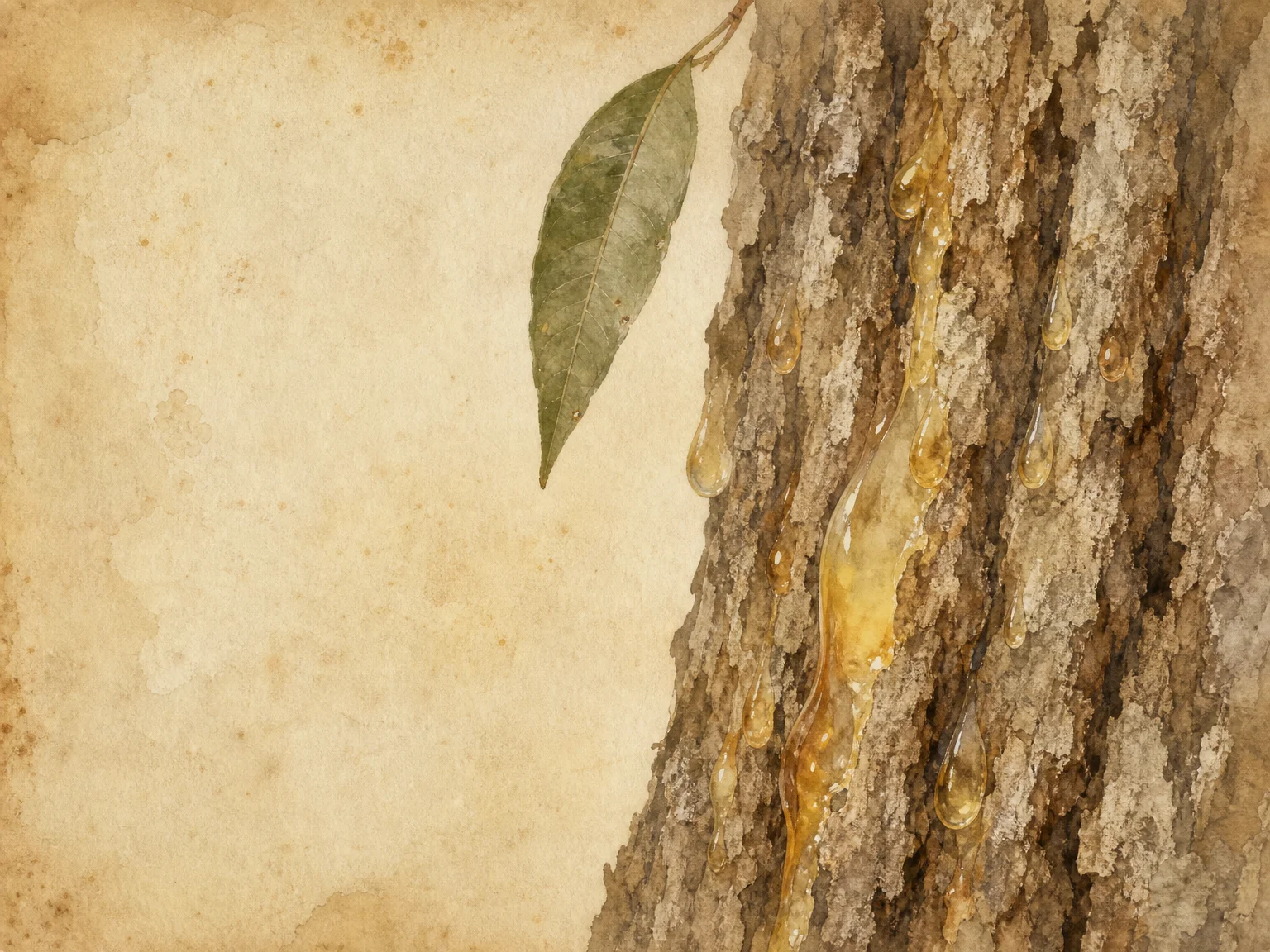
The word damar is Malay for "torch" or "resin" — a single syllable that covers an entire genus of trees and an entire forest economy. The most commercial grade in international trade, damar mata kucing ("cat's-eye dammar"), is exuded by Shorea javanica, a giant dipterocarp tree endemic to Indonesia and unknown anywhere else in the wild. Other grades — damar batu, damar temak, white and black dammar — come from sister species in the Shorea, Hopea, Vatica, Anisoptera and Vateria genera, across Southeast Asia and South India.
What makes dammar unusual is that the canonical harvest method is not extraction from wild forest but a planted forest. From around the 1880s, swidden farmers in the Krui area on the western coast of Lampung province, Sumatra, began inter-planting Shorea javanica seedlings into their rice and coffee plots. After roughly twenty-five years the Shorea canopy closes and the plot is no longer agriculture: it is forest, called repong damar in Krui, and it can be tapped for resin for two human generations. By the late 1990s the Krui repong covered around 50 000 hectares; roughly 80 % of Pesisir Barat households drew at least part of their livelihood from this multi-species, multi-storey, human-planted forest.
European industrial interest came late. Mastic — the eastern Mediterranean resin from Pistacia lentiscus — had been the picture varnish of choice in oil painting from the 16th century onwards, through Rembrandt, Vermeer and Reynolds, and would not be displaced until the 19th century. Dammar varnish was introduced to European studios in 1826, almost certainly by German restorers looking for a more stable, less polar, less rapidly yellowing alternative to mastic. Residual dammar was found in J.M.W. Turner's varnish bottle after his death in 1851; by the 1850s it was "much used in the United States." The trade has run continuously since.
A forest planted by farmers for resin — not extracted from wild forest, planted.