In Our Recipes · Ingredient Four

Shellac is the most Indian ingredient in the recipe.

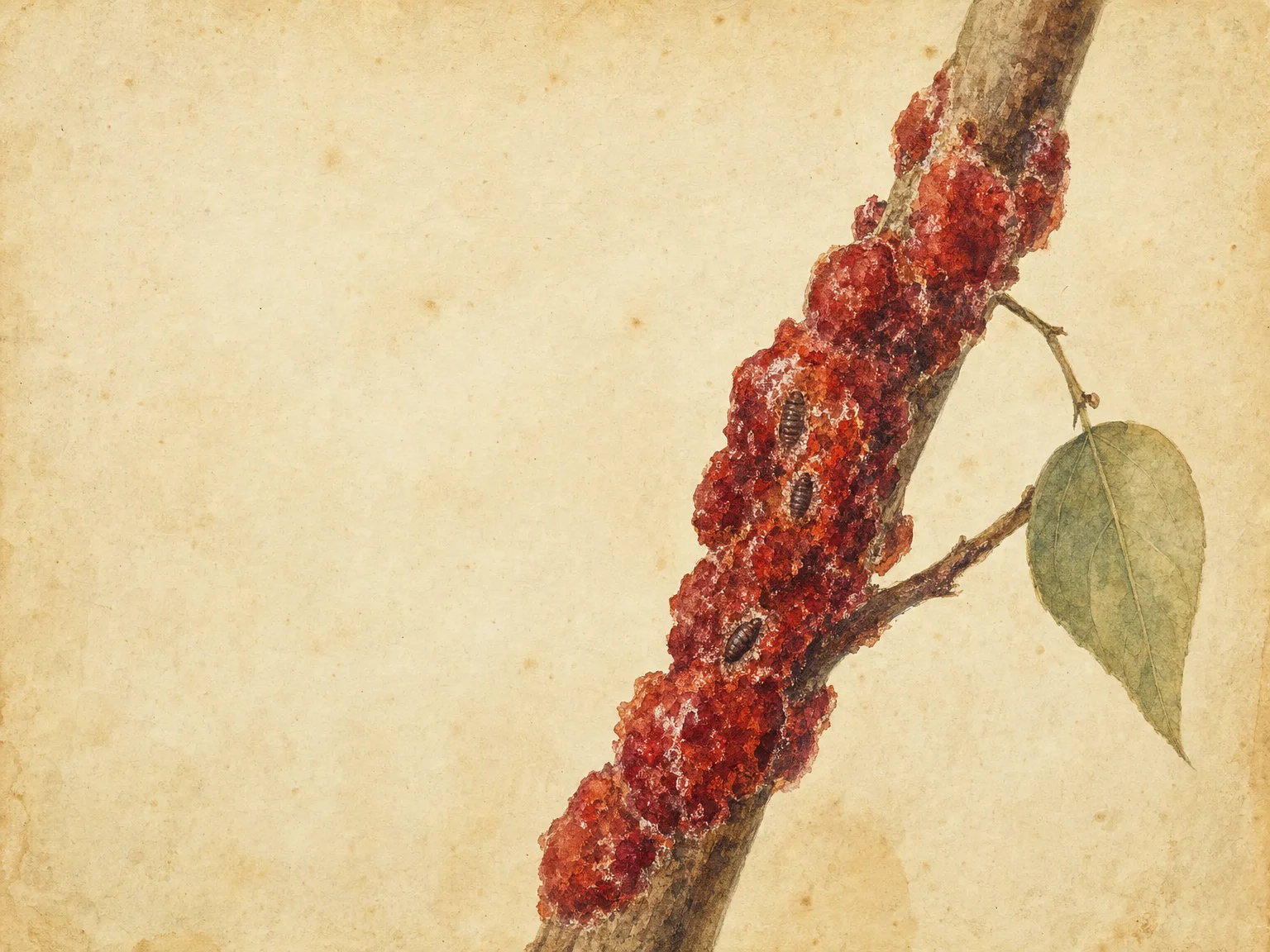
Kerria lacca

Secreted by Kerria lacca on Indian host trees — kusum, palash, ber. The Sanskrit name for the resin is lākṣā, the same word that gives Hindi lakh and English "lac" — literally one hundred thousand, after the swarming density of the insects on a branch. India produces at least half of all shellac on Earth, and around 4 to 6 million tribal-majority households farm it across Jharkhand, Chhattisgarh, Madhya Pradesh, Odisha and West Bengal.

Natural Resin · Quick-Drying

At a glance

The material in one panel.

Scientific name
Kerria lacca (Kerr, 1782) — syn. Laccifer lacca, Tachardia lacca
Family
Kerriidae · lac scale insects
Indian host trees
Kusum (Schleichera oleosa) · Palash (Butea monosperma) · Ber (Ziziphus mauritiana)
Function in paint
Alcohol-soluble resin · knot sealer · tannin blocker · quick-drying binder
Thermal range
Glass transition 41–48 °C · softening ~75 °C · melt ~120 °C (Yan et al., Polymers, 2021)
Composition
Mono- and polyesters of aleuritic acid + sesquiterpene acids (jalaric, shellolic, laksholic, butolic) · 3–5 % natural insect wax in seedlac
Regulatory status
US-FDA 21 CFR 73.1 (colour additive) + 21 CFR 175.300/380/390 (food-contact resinous coatings) · EU additive E 904 · JECFA "Acceptable" 1992 · EFSA 2024 ADI 4 mg/kg bw/day

Origin

The Indian resin that gave Sanskrit its word for one hundred thousand.

The lac insect — Kerria lacca, family Kerriidae — is native to the deciduous forests of India and South-east Asia. The Sanskrit name for the resin it produces is lākṣā, the same word that gives Hindi lakh and English "lac" — literally one hundred thousand, a reference to the swarming density of the insect crawlers on a host branch. The earliest written reference is in the Atharva Veda, composed roughly between 1200 and 900 BCE, where chapter 5 sukta 5 ("Laksha Sukti") is devoted entirely to lac. The Mahabharata records a Laksha Griha — a palace built of combustible lac and burnt down as a political plot — a story that itself preserves the cultural memory of lac as a daily material in the Vedic period.

The insect lives in colony on a small group of host trees: kusum (Schleichera oleosa), palash or "flame of the forest" (Butea monosperma), and ber (Ziziphus mauritiana). It pierces the phloem of young twigs, sucks the sap, and excretes a hard resinous shell that protects the colony from predators and desiccation. Indian cultivators have worked this cycle for millennia, with the harvested twigs ("sticklac") refined into seedlac and finally into shellac. Two strains run in counter-phase across the year: kusumi (winter aghani + summer jethwi crop on kusum) and rangeeni (rainy katki + summer baisakhi on palash and ber).

Commercial export to Europe began in the 17th century out of Bengal and Bihar. By the late 18th century French ébénistes had refined the technique that became "French polish" — shellac dissolved in alcohol, padded onto fine furniture in dozens of thin layers to build a glass-clear gloss. Between 1921 and 1928, 18 000 tonnes of shellac were used to press 260 million gramophone records for the European market; by the 1930s half of all shellac on Earth was being pressed into records, before vinyl displaced it. India produced — and still produces — the overwhelming majority of all of it.

Sanskrit lākṣā — the word for the resin and the word for one hundred thousand. The insects come in that order of magnitude.

Chemistry

A resin that hardens by evaporation, not oxidation.

Shellac is not a single compound but a network of esters and free acids built from one hydroxy-aliphatic and several sesquiterpene acid monomers. The dominant aliphatic monomer is aleuritic acid — 9,10,16-trihydroxyhexadecanoic acid — which is the workhorse film-former and the unit most papers use as the chemical fingerprint of shellac. The sesquiterpene fraction contains jalaric acid, shellolic acid and laksholic acid, plus their oxidised and reduced counterparts. Seedlac also carries 3 to 5 % of natural insect wax and the orange-red laccaic acid pigment family, both typically removed during refining into bleached or dewaxed shellac.

The defining trick — and the reason shellac sits next to linseed oil in a finisher's vocabulary but does the opposite job — is how the film forms. Linseed oil hardens by autoxidative cross-linking with atmospheric oxygen, irreversibly. Shellac forms its film by solvent evaporation: dissolve the dry flakes in ethanol, brush or pad on, the alcohol leaves, and a glass-hard amorphous resin remains. Below its glass transition (41–48 °C) the film is hard and brittle; above it the resin softens and flows. Differential scanning calorimetry on commercial shellac (Yan et al., Polymers, 2021) returns a softening point in the 75 to 80 °C window and a full melt around 120 °C — well above any habitable surface in India.

Because the film is held together by physical entanglement and ester bonds rather than oxidative cross-links, shellac has one property no synthetic polyurethane shares: reversibility. A worn or damaged shellac film can be re-dissolved with the same ethanol that built it, blended into a fresh coat, and seamlessly refinished. This is why a 250-year-old French-polished cabinet can be restored coat-on-coat without sanding away history. A second-generation effect — slow self-esterification of free aleuritic acid as shellac ages — gradually raises the glass-transition temperature and lowers solubility, the chemical reason a very old shellac flake stops dissolving as cleanly as a fresh one.

Why we still use it

What shellac does that no synthetic alkyd can match.

Three traits keep shellac in a serious wood finisher's kit a hundred and fifty years after synthetic resins began to displace it. First, knot and tannin sealing — the polar ester groups in shellac bind to the resinous extractives that bleed from pine knots, redwood, mahogany and teak, and the alcohol-borne film locks them in before the next coat can lift them. This is why "shellac-based primer" remains a category name well into the twenty-first century, decades after shellac stopped being competitive on flat-paint cost.

Second, fast cure under skilled hands. A thin shellac coat is touch-dry in 15 to 30 minutes; multiple coats can be padded on in a single day. Compare this with the 24- to 48-hour linseed-oil cure per coat. For a primer or barrier coat under a slower oil topcoat, that speed is structural — the carpenter can move on to the next operation the same morning.

Third, reversibility and breathability. A cured shellac film stays soluble in fresh ethanol — which lets it be refreshed, blended, or repaired without stripping the wood. It is also more permeable to water vapour than a polyurethane film, so wood beneath it can equilibrate to ambient humidity — important in Indian monsoon climates where a hermetically sealed film traps moisture against the substrate. In a natural-paint recipe, shellac sits where linseed oil cannot: in the alcohol-borne barrier layer below the oxidatively curing oil, blocking the resinous substrate while the oil topcoat builds toughness above.

Tree-host agroforestry

A resin that only exists because the host trees are still standing.

Lac is not plantation agriculture. The insect lives on three specific deciduous host species, all native to the forest mosaic of central and eastern India: kusum (Schleichera oleosa), a slow-growing 12-to-20-metre hardwood of the Sapindaceae family; palash (Butea monosperma), the "flame of the forest" whose vermilion flowers carpet the dry deciduous belt every March; and ber (Ziziphus mauritiana), the small thorny jujube whose fruit doubles as a household food crop. To farm lac you cannot fell these trees — the insect needs young, sap-rich twigs to colonise, year after year. The economic logic is the inverse of timber: the more lac a household harvests, the more aggressively it protects the host canopy. ICAR-IINRG documents per-tree yields of 6 to 10 kg on a mature kusum, 1.5 to 6 kg on ber and 1 to 4 kg on palash.

Two strains of Kerria lacca run on opposite calendars, doubling the productive use of the same host stand. The kusumi strain cycles on kusum: the aghani crop is inoculated in June-July and harvested in January-February, the jethwi crop is inoculated in January-February and harvested in June-July — winter resin plus summer resin off the same tree. The rangeeni strain cycles on palash and ber: the katki crop is inoculated in June-July and harvested in October-November during the monsoon tail, the baisakhi crop runs from October-November to June, harvested in the high summer heat. A single household with a few dozen mature trees can pull two lac crops a year without exhausting the colony or the canopy.

The carbon-and-livelihood arithmetic is unusually aligned. A successful lac year can lift a tribal household income from roughly ₹20 000 to ₹65 000 or more — documented in Tata Trusts case studies from Jamtara, Jharkhand. That income is conditional on a standing forest of kusum and palash and ber — trees that, in the absence of the lac economy, would be more profitable felled for timber or cleared for cropland. Shellac is the rare globally traded commodity whose supply chain rewards forest retention rather than land conversion. The Indianness of shellac is not just sentiment; it is the only ingredient in the LEINOS recipe whose existence presupposes living Indian trees.

You cannot farm lac on a felled tree. The harvest depends on the canopy staying up — year on year, generation on generation.

In LEINOS recipes

Where shellac sits in the line.

Shellac appears in three LEINOS products — all on the wall and decorative-finish side of the catalogue rather than in the wood-oil topcoats. In each case it is the alcohol-soluble Indian resin doing what it has done in European recipes for two centuries: a fast-drying, breathable, reversible binder modifier, here delivered as "shellac soap" in a water-borne formulation alongside natural waxes and resin soaps. The wood-oil topcoats (290, 236, 260, 259) use linseed-and-resin-ester chemistry instead — shellac is not in their public TDS composition strings. The three confirmed shellac-bearing products are listed below; each composition is taken directly from the product TDS.

Safety · Responsible Use

Natural. Not unconditional.

Purified shellac is one of the most widely cleared natural resins in the global food, pharma and coatings supply chain. The US-FDA lists it as a colour additive (21 CFR 73.1) and as an indirect food-contact substance under three resinous-coating provisions (21 CFR 175.300, 175.380, 175.390) — usable as anticaking, drying, humectant, processing aid and surface-finishing agent. The EU lists it as food additive E 904 at quantum satis in eleven food categories, with purity criteria in Commission Regulation (EU) 231/2012. JECFA evaluated bleached shellac in 1992 and concluded its use as a coating, glazing and surface-finishing agent externally applied to food was "Acceptable" — no ADI was numerically allocated at the time on the basis that absorption was expected to be negligible.

EFSA re-opened the file in 2024 and, on a NOAEL of 400 mg/kg bw/day from a two-generation reproductive study, derived a numerical ADI of 4 mg/kg bw/day for wax-free shellac produced by physical decolouring. In pharmaceuticals, shellac has monographs in the United States Pharmacopoeia (USP), the European Pharmacopoeia (Ph.Eur.) and the Japanese Pharmacopoeia (JP), used industry-wide for enteric coatings, taste-masking films, moisture-protective tablet glazes and extended-release matrix tablets. Acute toxicology shows no adverse effects from oral, dermal, ocular or respiratory exposure in animal studies; cosmetic formulations up to 6 % shellac have shown no mutagenic or sensitising findings.

  • Insect-derived — vegan and Jain status

    Shellac is not vegan: it is an animal-origin material, secreted by Kerria lacca and harvested with the insects embedded in the resin. Published estimates of insect mortality per kilogram of finished shellac range widely — 50 000 to 300 000 insects per kg — depending on whether the lac is harvested with the dead colony or after the new generation of crawlers has emerged. Under the Jain principle of ahimsa, which extends non-violence to all sentient life including insects, shellac is not Jain-compliant in the strict reading. Buyers requiring a vegan or Jain finish should specify a plant-protein alternative such as Zein (corn-derived) or the linseed-and-wax route, which is fully plant-and-mineral.

  • Heat performance fine — not for cookware contact

    Shellac softens at ~75 °C and fully melts around 120 °C. No habitable surface in India, including a sun-exposed terrace deck or a Delhi summer worktop, reaches that temperature; a cured shellac film stays solid and unmigrated. The exception is direct contact with hot utensils — a shellac-finished worktop will mark under a pan straight from the hob in a way a linseed-hardwax-oil film will not. For kitchen surfaces, hardwax-oil topcoats do the load-bearing thermal work, not shellac.

  • Indian rural livelihoods — the most home-grown ingredient

    India produces at least half of all lac on Earth (around 20 000 tonnes of raw lac per year), and the cultivation supports an estimated 4 to 6 million households — the great majority of them tribal communities in Jharkhand (~39 % of national production), Chhattisgarh (~30 %), Madhya Pradesh, Odisha and West Bengal. ICAR-IINRG (Indian Institute of Natural Resins and Gums) in Ranchi — formerly the Indian Lac Research Institute, founded in 1924 — is the central public-sector research body. Lac is one of the rare premium agroforestry export commodities sustained by tribal smallholders rather than plantation capital.

Got Questions?

Questions about Shellac?

Quick answers on formulation, application and Indian-climate suitability. Pulled from our full FAQ and TDS library.

No. Shellac is an animal-origin material — a resin secreted by the lac insect Kerria lacca and harvested with the colonies still embedded in the resin. Published estimates put insect mortality at 50 000 to 300 000 insects per kilogram of finished shellac, depending on harvest method. Under the Jain principle of ahimsa, which extends non-violence to all sentient life including insects, shellac is also not Jain-compliant in the strict reading. Buyers requiring a vegan or Jain finish should specify a plant-protein alternative such as Zein (corn-derived) or ask LEINOS for the linseed-and-wax route, which is fully plant-and-mineral. We do not present shellac as plant-derived.
Talk to us

Specify with confidence.

Need the TDS, a sample, or guidance on which LEINOS product is right for your project?