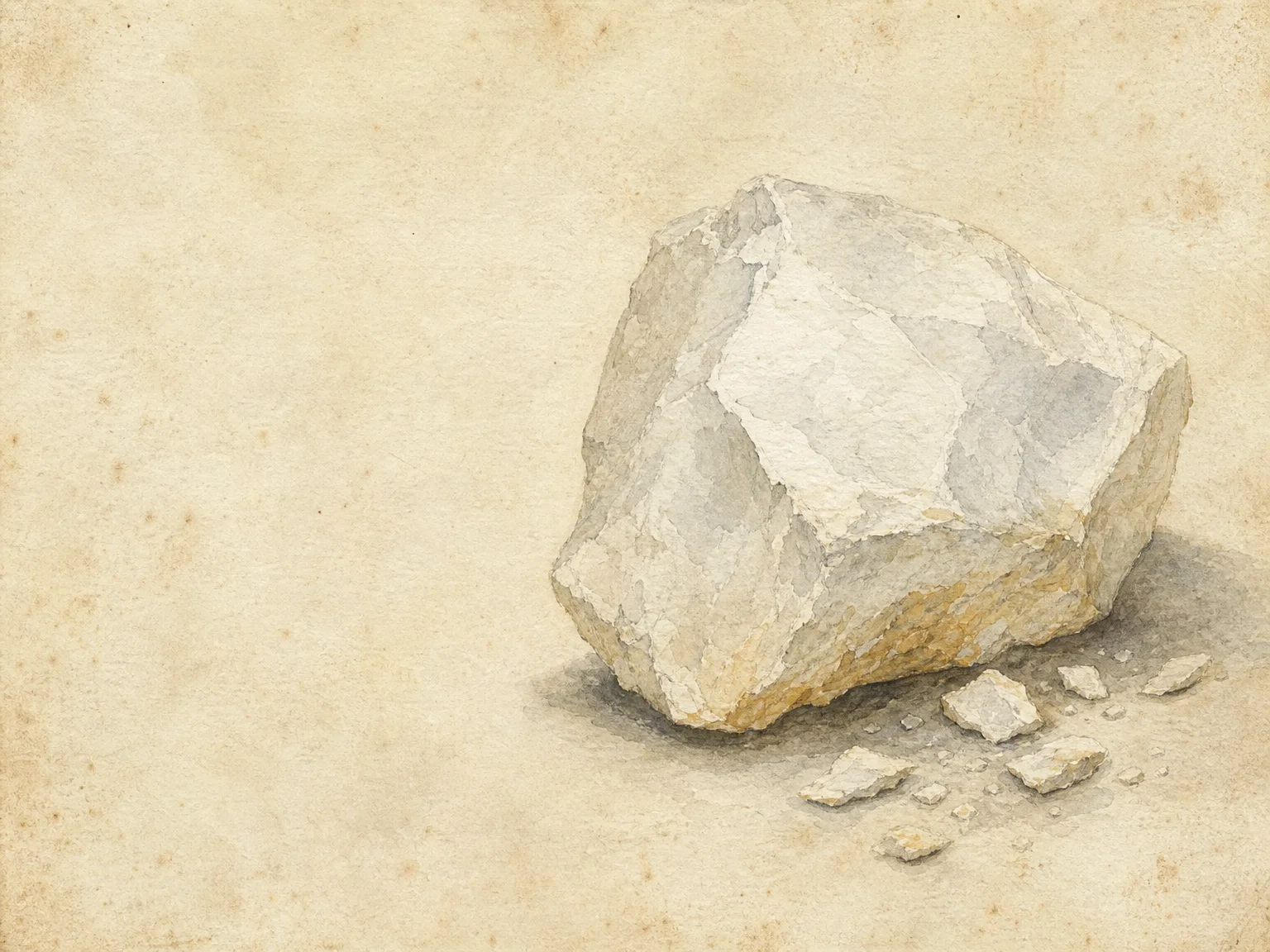
In Our Recipes · Ingredient Six

White clay is the single mineral vote in a recipe of oils, waxes and resins.

Kaolinite · Al₂Si₂O₅(OH)₄

Kaolinite — a mineral formed by million-year weathering of granitic feldspar. The pseudo-hexagonal platelets that pack into a vapour-open paint film, scatter visible light, and let lime-plastered walls keep breathing through monsoon humidity. The natural-stone counterpart in a recipe otherwise grown in fields and forests.

Mineral Filler · Breathable Opacifier

At a glance

The material in one panel.

Mineral name
Kaolinite — principal mineral of kaolin / china clay
Chemical formula
Al₂Si₂O₅(OH)₄ · Al₂O₃·2SiO₂·2H₂O · CAS 1332-58-7 · EC 310-194-1
Mineral group
Phyllosilicate · kaolin subgroup · 1:1 TO dioctahedral layer silicate
Origin
Cornwall (UK) · Georgia (USA) · Brazil · China · India (Kerala — 96 % kaolinite grade, DMG-classified "world-class")
Function in paint
Mineral filler · opacifier · body-giver · breathable extender · partial TiO₂ replacement
Particle size
Pseudo-hexagonal platelets ~0.5–2 µm · ceramic-grade ≥85 % under 2 µm
Regulatory status
US-FDA GRAS 21 CFR 186.1256 (indirect food substance) · EU additive E 559 revoked 31 Jan 2014 under Reg. 1129/2011 (EFSA aluminium-intake assessment) · REACH-registered, no harmonised hazard, not on SVHC

Origin

The clay that named itself after a Chinese hill.

Kaolinite is a clay mineral born of slow chemical weathering. Over geological timescales — hundreds of thousands to millions of years — granitic and feldspathic rocks exposed to warm, humid climates lose their alkali metals to circulating groundwater, and the residual aluminium and silicon atoms re-organise into a layered hydrous aluminosilicate. The result is kaolin, an iron-poor white earth that has been useful to human craft for at least 1 300 years.

The name itself records the original deposit. Around the seventh century CE, Chinese potters at Jingdezhen, Jiangxi Province, began firing a translucent white ceramic from a clay quarried at a hill called Gaoling — "high ridge". The clay became inseparable from the ware, and Gaoling was rendered into French in 1727 as kaolin by the Jesuit missionary Père François Xavier d'Entrecolles in his celebrated letters describing Jingdezhen porcelain manufacture. The English term followed within a generation. By 1746 William Cookworthy had located equivalent deposits in the granite moors of Cornwall, and in 1768 was granted the English patent for porcelain made from Cornish china clay — the same hard-paste body the Chinese had been making for a thousand years.

Today commercial kaolin is mined on every continent. The dominant deposits are Cornwall (UK), the Sandersville district of central Georgia (USA), Pará and Amapá states of Brazil, Suzhou and Maoming districts of China — and the southern Kerala coast of India, where the Trivandrum and Kollam mines yield clay graded at 96 % kaolinite, considered "one of the finest quality clay and world class" by the Kerala Department of Mining and Geology. India ranks among the world's leading kaolin producers, accounting for an estimated 19 % of world output (USGS Minerals Yearbook 2023).

Kaolin took its name from a Chinese hill — Gaoling, the high ridge — and has kept it for 1 300 years.

Chemistry

Two sheets, hydrogen-bonded — the simplest clay structure there is.

Kaolinite is a phyllosilicate: a "leaf-silicate", built from atomic sheets stacked like pages in a book. Within the family of clay minerals it sits in the simplest subgroup, the 1:1 layer silicates, also called TO clays — one tetrahedral sheet of silicon-oxygen rings bonded directly to one octahedral sheet of aluminium-oxygen-hydroxyl, via shared oxygen atoms. Each composite T-O layer is electrostatically neutral; adjacent layers are held together by hydrogen bonds between the basal hydroxyls of one octahedral sheet and the basal oxygens of the next tetrahedral sheet.

That layered arrangement determines almost every property kaolin is valued for. The cleavage between layers gives kaolin's characteristic pseudo-hexagonal platelet morphology — flat, 0.5 to 2 µm wafers that scatter visible light and slide past each other in suspension, producing high covering power, low abrasion, and the smooth flow critical to paper-coating and paint applications. Hydrogen bonding — rather than the metal-cation bridging found in smectite-group clays such as bentonite — explains why kaolinite has a very low cation-exchange capacity, very low shrink-swell behaviour and limited interlayer water uptake. It is the stable clay, the one that does not change volume on wetting.

The chemistry is fixed: Al₂Si₂O₅(OH)₄, or equivalently Al₂O₃·2SiO₂·2H₂O. Heat the mineral past about 550 to 600 °C and the hydroxyl water is driven off; the crystalline platelet collapses into metakaolin, an amorphous aluminosilicate with pronounced pozzolanic reactivity — it reacts with calcium hydroxide in the presence of water to form calcium silicate hydrate, the same binding phase that sets Portland cement. This is why calcined kaolin is now a recognised supplementary cementitious material in low-carbon concrete and why heated kaolin re-appears as the "calcined clay" in modern silicate-based paints.

Why we still use it

The mineral counterpart in a recipe of oils, waxes and resins.

A LEINOS clay paint or mineral plaster is, at its most reductive, a thin natural binder carrying a heavy load of mineral solids onto a wall. Those mineral solids have to do four things: cover the substrate, scatter enough visible light to feel white, remain vapour-open so the wall behind can release moisture, and remain chemically inert across a wide pH range so the binder system does not corrode them. Kaolinite does all four cleanly.

In paint and clay-paint formulation, kaolinite is the workhorse mineral filler and opacifier. The platelets pack at the surface of the dried film and refract light; calcined grades, with their disrupted layer structure, scatter even more strongly, delivering enough hiding power to substantially replace titanium dioxide in opaque interior paints — a 1990s-onwards substitution well-documented across the peer-reviewed coatings literature. Kaolinite is also chemically inert across the relevant pH range, non-abrasive, and low in heat and electrical conductivity, so it co-exists peacefully with lime binders (pH ≈ 12), silicate paints, casein emulsions and oil-modified binders alike.

The other property is breathability. Synthetic acrylic dispersions form continuous polymer films that block water-vapour passage; mineral fillers in a vapour-open binder do the opposite. Clay-paint formulations typically run SD-values (steam-diffusion equivalent air-layer thickness) of 0.02 to 0.05 m versus 1+ m for acrylic exterior paints — two orders of magnitude more permeable. On a lime-plastered wall in monsoon humidity this is the difference between a wall that absorbs and releases moisture and a wall that traps it behind a polymer film. Inside the LEINOS recipe, kaolinite is also a deliberate identity statement: the brand's other five ingredients are biological — plant oils, plant waxes, plant resins, an insect-secreted shellac, an insect-produced wax. Kaolinite is the single mineral counterpart, the natural-stone vote in a system otherwise grown in fields and forests.

Kerala — the world-class deposit on LEINOS's home market

A 96 % kaolinite earth, mined within a day's drive of the south-Indian project sites the brand serves.

Of the half-dozen kaolin districts that dominate world output, one sits inside the market LEINOS has chosen for its second life: the Trivandrum and Kollam belt of southern Kerala. The Kerala Department of Mining and Geology grades the run-of-mine clay from this belt at approximately 96 % kaolinite, and in its own published technical literature calls the deposit "one of the finest quality clay and world class" — language a state mineral regulator does not use lightly. The Kerala deposits are residual kaolins, weathered in place from the Archaean gneisses and charnockites of the south-Indian craton over geological timescales similar to the Cornish and Georgian districts the European and American paint industries have drawn on for two centuries.

The scale follows the grade. According to the U.S. Geological Survey's Minerals Yearbook 2023, India accounts for an estimated 19 % of world kaolin production — among the top three producing nations by tonnage, and the only one of those whose principal deposits sit inside South Asia's monsoon climate zone. The Kerala state register lists 25 working china-clay leases under the Mineral Conservation and Development Rules (MCDR 2017), each operating under an approved Mining Plan with post-mining rehabilitation commitments. For an Indian specifier, kaolin is a domestic mineral with traceable per-mine production data — not a black-box import.

For LEINOS in India this is more than provenance trivia. The brand sources processed European kaolin grades for its German manufacturing today; the chemistry of those grades is the same hydrated aluminosilicate Al₂Si₂O₅(OH)₄ that the Kerala mines produce by the tonne. If kaolinite is the single mineral vote in the LEINOS recipe — the natural-stone counterpart to oils, waxes and resins grown in fields and forests — then it is also the one ingredient in the system whose finest known deposit on Earth sits inside the country the brand now calls its second home.

India produces an estimated 19 % of the world's kaolin; the finest of it comes from a belt that runs through LEINOS's second home.

In LEINOS recipes

Where white clay sits in the line.

Kaolinite is the natural mineral filler on the walls side of the LEINOS catalogue. TDS-verified, the canonical clay-bearing recipe is 655 Clay Paint, whose published composition names "Clay" as a primary mineral solid alongside chalk and plant-derived cellulose binders. The adjacent mineral-paint family (650 Interior White Paint, 660 Natural Resin Emulsion Paint, 622 Mineral Plaster Primer) declares generic "Mineral fillers" without naming the species — kaolin is the standard inert extender across this category in the wider European mineral-paint industry, but per-SKU confirmation requires the internal full SDS rather than the public technical data sheet. The pure lime paints (665 Lime Paint, 667 Lime Brush Rendering) and the gypsum/lime scrapers (683, 684) are not kaolin-bearing — those are pure calcium-mineral systems. Carnauba- and beeswax-bearing wood-finish products (290, 280) do not contain kaolin; the mineral lives on the walls side of the catalogue.

Safety · Responsible Use

Natural. Not unconditional.

Kaolinite is one of the most extensively cleared natural minerals in food, cosmetic and pharmaceutical use. The U.S. Food and Drug Administration formally affirmed kaolin as GRAS under 21 CFR 186.1256 for indirect food-substance use — as a constituent of paper and paperboard in contact with food, with no limitation other than current good manufacturing practice. The European Union took a different path: kaolin was listed as direct food additive E 559 (Aluminium silicate, Kaolin) as anti-caking agent under Regulation (EC) 1333/2008, but following EFSA's 2013 conclusion that combined dietary aluminium intake from aluminium-silicate additives exceeded the provisional tolerable weekly intake, the European Commission revoked E 559 on 31 January 2014 under Regulation (EU) 1129/2011. The revocation is specific to food use; kaolin remains fully cleared in the EU for cosmetics, pharmaceuticals (it is the active in Kaopectate and related oral preparations), pigments, paints and ceramics. Under REACH the substance is registered and not classified as hazardous in the harmonised Classification & Labelling inventory.

The honest qualification is occupational. The mineral kaolinite itself is not respirable crystalline silica (free quartz); it is a hydrated aluminosilicate sheet mineral with a different chemistry and a different hazard profile. But some kaolin deposits geologically co-occur with quartz, and prolonged inhalation of high-concentration kaolin processing dust has produced documented cases of kaolinosis — a generally mild, restrictive pneumoconiosis — in Georgia kaolin-processing workers across the 1970s to 1990s. OSHA sets a Permissible Exposure Limit of 15 mg/m³ total dust and 5 mg/m³ respirable fraction (8-hour TWA) for kaolin containing no asbestos and less than 1 % crystalline silica; ACGIH recommends a tighter TLV of 2 mg/m³ respirable. These are industrial-hygiene numbers for processing plants — not for the finished application of a kaolin-bearing paint to a wall.

  • The mineral is cleared. Sanding a cured film is not

    The raw mineral has GRAS status in the U.S., REACH-registered non-hazardous classification in the EU, and a century of pharmacopoeial use orally. A cured clay-paint film is the mineral plus binders, pigments and any trace additives; the in-place wall is inert. Where dust handling matters is during paint preparation (powder-form clay paints sold dry need to be mixed wet in a ventilated area) and during removal — sanding a cured kaolin-paint wall for refinish should be done with PPE per local occupational-hygiene rules, on the same basis as any mineral coating.

  • Kaolinite ≠ crystalline silica — distinguish carefully

    Kaolinite as a chemical species is hydrated aluminosilicate Al₂Si₂O₅(OH)₄ — sheet-structure, not the free-quartz mineral SiO₂ that drives silicosis. However, some kaolin deposits geologically co-occur with quartz, and refined kaolin sold for technical use is graded for residual crystalline silica content. The OSHA PEL and ILO/WHO ICSC apply to kaolin under 1 % crystalline silica; above that, quartz-dust rules apply. LEINOS, like other European mineral-paint producers, sources processed kaolin grades within those purity bands.

  • Mining footprint — real, governed by transparent frameworks

    Open-pit kaolin mining is landscape-altering. The Indian Mineral Conservation and Development Rules (MCDR 2017) require post-mining rehabilitation and approved Mining Plans for every Indian kaolin lease; the Kerala Department of Mining and Geology publishes the per-mine production register for the state's 25 working china clay mines. At international level the Initiative for Responsible Mining Assurance (IRMA) Standard v.1.0 (2018) covers all industrial-scale mining of all mined materials except energy fuels — kaolin is in scope, and IRMA's third-party site audits are the most demanding cross-commodity framework currently available. Unlike carnauba's documented labour issue, industrial kaolin mining is not associated with a category-wide labour-rights crisis — but the mining footprint is real, and the responsible position is to say so rather than imply otherwise.

Got Questions?

Questions about White Clay?

Quick answers on formulation, application and Indian-climate suitability. Pulled from our full FAQ and TDS library.

The mineral is GRAS in the United States as an indirect food substance — used as a constituent of paper and paperboard in food packaging under 21 CFR 186.1256, with no limitation other than current good manufacturing practice. In the European Union kaolin was historically the direct food additive E 559 (anti-caking agent in instant coffee, milk powder, spices) but was revoked on 31 January 2014 under Regulation 1129/2011 — not because of an acute toxicity finding, but because EFSA's 2013 assessment concluded that combined dietary intake of aluminium from aluminium-silicate additives exceeded the provisional tolerable weekly intake. Kaolin remains cleared in the EU for cosmetics, pharmaceuticals (Kaopectate), pigments, paints and ceramics. The mineral has a centuries-long pharmacopoeial track record of low toxicity.
Talk to us

Specify with confidence.

Need the TDS, a sample, or guidance on which LEINOS product is right for your project?