The mechanism
How a clay wall buffers humidity.
Clay minerals are built from microscopic plate-shaped particles with an enormous internal surface area. When the surrounding air is humid, water molecules are drawn into the spaces between those platelets; when the air dries, the same water is released back. A clay-paint surface therefore works as a passive, fully reversible moisture buffer — it shaves the peaks off a room’s humidity swing without any energy, membrane, or mechanism.
The cured coating stays open-pore. Water vapour passes through it freely, so the substrate beneath continues to breathe and dry rather than trapping moisture behind a sealed film. This is the structural difference from a conventional acrylic emulsion, which forms a continuous polymer film: the two can look similar on day one, but only one of them lets the wall keep exchanging moisture through the coat.
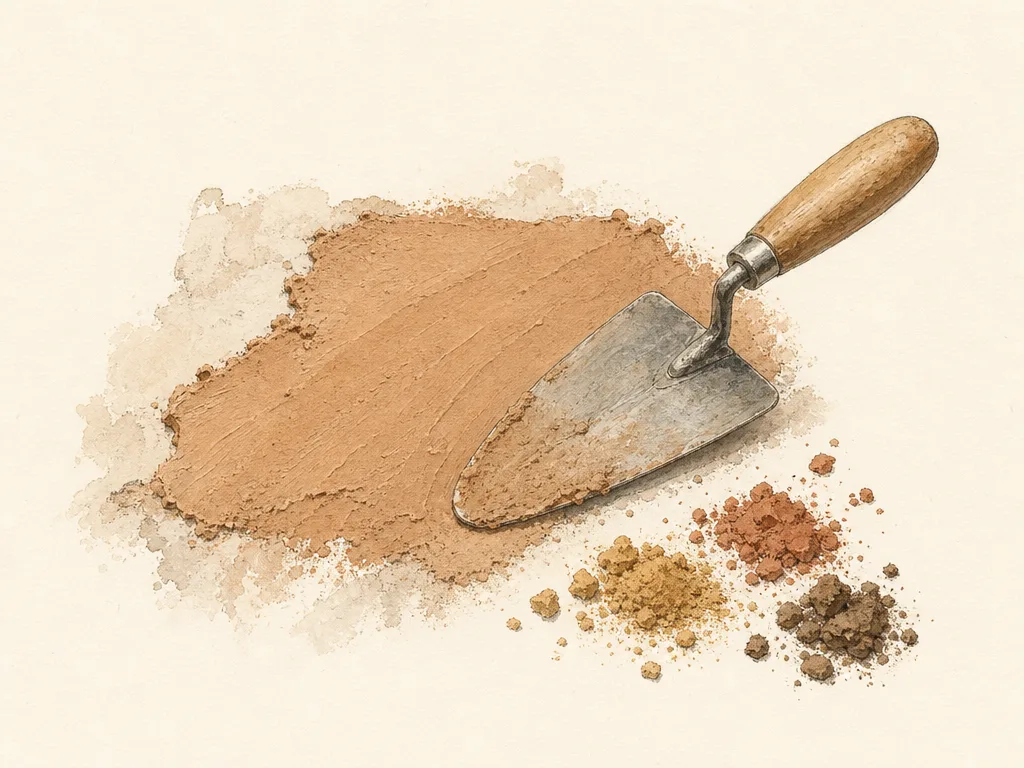
Colour in a clay paint is mineral pigment — iron-oxide reds, ochres, kaolin white — carried inside the clay-and-cellulose matrix as part of the wall’s substance. Because the pigment is body, not a surface tint, the matt surface catches raking light with a depth that a surface tint on a film-forming paint does not reproduce.
The wall does work — it buffers the room’s humidity instead of sealing it away.