Paint Types · Mineral

Lime paint makes the wall hostile to mould.

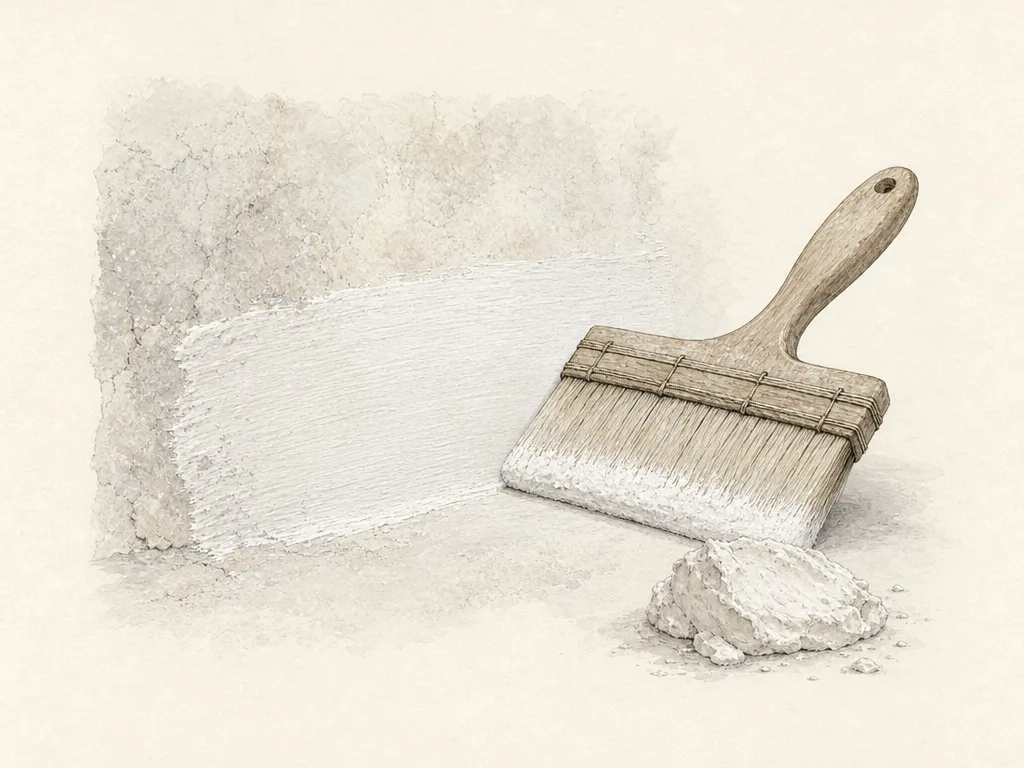
A mineral interior paint bound by slaked lime (Sumpfkalk) that cures by carbonation, not by drying. The cured surface is microcrystalline calcium carbonate: open-pore, highly vapour-permeable, and alkaline enough that mould finds no foothold — the canonical specification for humid Indian rooms.

Mineral wall paint

What it is

What is lime paint?

Lime paint is a mineral wall paint in which slaked lime — calcium hydroxide (Ca(OH)₂), known in German as Sumpfkalk — is carried in water together with chalk, marble powder, and titanium dioxide, bound by cellulose ether and a small organic binder. Unlike an acrylic emulsion, which dries by water evaporation into a polymer film, lime paint cures by carbonation: atmospheric CO₂ reacts with the calcium hydroxide to form calcium carbonate (CaCO₃) — the same mineral the underlying lime plaster is made of. The result is not a coating on the wall but a chemical continuation of it. Two properties follow from that chemistry. First, the cured surface stays open-pore and highly vapour-permeable (Sd value approx. 0.01): water vapour passes freely, so no film traps moisture behind the wall. Second, calcium hydroxide is strongly alkaline (pH approx. 13 during cure), which makes the surface itself hostile to mould spores without any added biocide. LEINOS Lime Paint 665 is the reference product in this category for the India catalogue — VOC less than 1 g/l (EU Category a), made in Germany by Reincke Naturfarben.

Paint type
Mineral · slaked-lime (Sumpfkalk) paint
Binder / cure
Calcium hydroxide → carbonation (Ca(OH)₂ + CO₂ → CaCO₃)
Body minerals
Chalk, marble powder, titanium dioxide
Finish
Matt · natural mineral surface · recoatable
Key property
High alkalinity (pH approx. 13) → mould-resistant surface
Vapour permeability
Very high · Sd value approx. 0.01
VOC content
< 1 g/l (EU Cat. a · limit 30 g/l · Directive 2004/42/EC)
Coverage
Approx. 54–86 sq ft per litre per coat (substrate-dependent)
Drying & coats
Touch-dry approx. 6–12 h · recoatable approx. 24 h · 2–3 coats
Use
Interior absorbent mineral walls & ceilings · incl. humid rooms
Reference product
LEINOS Lime Paint 665 · Made in Germany

The mechanism

How lime cures — and why that resists mould.

Slaked lime is calcium hydroxide. On an absorbent mineral wall, water carries it into the surface pores; as the water leaves, atmospheric carbon dioxide converts the calcium hydroxide back into calcium carbonate — the mineral limestone is made of, and the mineral the wall’s lime plaster is built from. The paint does not dry into a film. It becomes the wall. This process, carbonation, continues slowly over several weeks after the final coat.

The cured surface stays open-pore. Water vapour from bathroom steam, kitchen condensation, or monsoon humidity passes freely in both directions, so moisture is never trapped behind a sealed skin — the Sd value is approximately 0.01, almost no resistance to vapour movement at all. This is the structural opposite of a conventional emulsion, whose polymer film acts as a vapour barrier.

The second consequence is alkalinity. Calcium hydroxide cures at a pH of approximately 13 — strongly alkaline, an environment in which mould spores and most bacteria cannot establish. The surface is not treated against mould with an added biocide; it is chemically hostile to mould through its own cured composition. The chemistry is the protection.

The paint does not dry into a film. It cures into the wall — and stays alkaline enough to repel mould.

India context

The mineral paint for damp Indian rooms.

India’s most common interior paint failure is not colour fade — it is moisture. Bathrooms, kitchens, basement walls, and coastal-city interiors see humidity high enough that conventional acrylic emulsion blisters, moulds, and peels within a monsoon season or two: the film traps moisture, trapped moisture breeds mould, and mould ruptures the film. Lime paint breaks that chain at both points — the open-pore surface never traps moisture, and the alkalinity makes mould growth on the surface itself unfavourable.

The canonical lime-paint brief in Indian interiors covers humid bathrooms and kitchens, heritage havelis and conservation work (where lime plaster is already the substrate and lime paint is the chemistry-compatible topcoat), and any space where an architect needs to specify mould resistance without biocide chemistry. The 665 TDS is explicit about its suitability for humid rooms.

Lime paint is the damp-room counterpart to clay paint. Clay buffers indoor humidity through hygroscopic sorption — the right tool for dry living rooms and bedrooms. Lime resists mould through high alkaline pH — the right tool where the moisture load or the mould risk is active. The two mechanisms are complementary, not interchangeable: match the paint chemistry to the room’s moisture condition.

At a comparison

Lime paint vs standard acrylic emulsion

Both are water-borne interior wall paints and can look alike on a sample card. They behave differently in a humid room, because the cure chemistry — and the vapour relationship with the wall — are opposite.

PropertyLime paint (LEINOS 665)Standard acrylic emulsion
Cure mechanismCarbonation — Ca(OH)₂ + CO₂ → CaCO₃ (chemical)Water evaporation → polymer film
Surface structureOpen-pore mineral matrix — vapour passes freelyContinuous polymer film — vapour barrier
Vapour permeabilityVery high — Sd value approx. 0.01Lower; the film resists vapour movement
Mould resistanceNatural — high alkaline pH (approx. 13), no biocideNone inherent; relies on added biocide
VOC content< 1 g/l (EU Cat. a)Varies; commonly higher
FinishMatt, mineral depthMatt to sheen, uniform plastic look

LEINOS 665 figures are from the Technical Data Sheet. Competitor columns are qualitative — Sd values, VOC, and biocide use vary by brand and grade; always read the specific product label.

Safety · Responsible Use

Natural. Not unconditional — and caustic while wet.

Lime paint is solvent-free, plasticiser-free, and very low VOC, but slaked lime is caustic while wet. The 665 TDS states plainly that it causes skin irritation, causes serious eye damage, and may cause respiratory irritation — a lime-specific hazard that does not apply to clay or emulsion paints. Wear protective gloves and eye/face protection during mixing and application, work only in well-ventilated rooms, and avoid inhaling the spray mist. If wet lime contacts the eyes, flush immediately with water and seek medical attention.

The hazard is the wet product, not the finished wall: once carbonation is complete the surface is calcium carbonate — inert, the same mineral as limestone. Mask adjacent timber, metal, glass, and stone before mixing, since lime stains and corrodes on contact and splashes are hard to remove once cured. Apply only to sound, absorbent mineral substrates; the product is not ready-to-use and must be diluted with up to 20% water. The full hazard register lives on the product Safety Data Sheet, available from LEINOS India.

  • Caustic when wet — gloves and eye protection

    The 665 TDS lists serious eye damage and skin irritation for the wet product. Protective gloves and eye/face protection are mandatory during mixing and application — this is lime-specific chemistry, not optional site hygiene.

  • Right room, wrong room

    Lime paint is for absorbent interior mineral surfaces, including humid rooms (bathrooms, kitchens, basements). It is not for wood, metal, glazed tile, non-absorbent surfaces, gypsum board without 622 primer, or any exterior application.

  • Not ready to use — dilute

    The TDS is explicit: the product is NOT ready-to-use. All coats must be diluted with up to 20% water, stirred very well, and applied in 2–3 coats. Applying undiluted risks uneven coverage and poor carbonation.

Got Questions?

Questions about lime paint?

Quick answers on formulation, application and Indian-climate suitability. Pulled from our full FAQ and TDS library.

Lime paint is a natural mineral wall paint in which slaked lime (calcium hydroxide, Sumpfkalk) is carried in water with chalk, marble powder, and titanium dioxide — with no acrylic polymer, solvent, or plasticiser. It does not dry into a film; it cures by carbonation, as atmospheric CO₂ converts the calcium hydroxide into calcium carbonate, the same mineral the underlying lime plaster is made of. The cured surface is open-pore, highly vapour-permeable, and alkaline enough to resist mould. LEINOS Lime Paint 665 is the reference product, with VOC below 1 g/l.
Talk to us

Specify with confidence.

Need the TDS, a sample, or guidance on which LEINOS product is right for your project?

Written by the LEINOS India technical team, in collaboration with
Reincke Naturfarben R&D, Lower Saxony.

Last updated