In Our Recipes · Ingredient Three

Beeswax is the breath and plasticiser of every hardwax oil.

Apis mellifera · Cera Alba

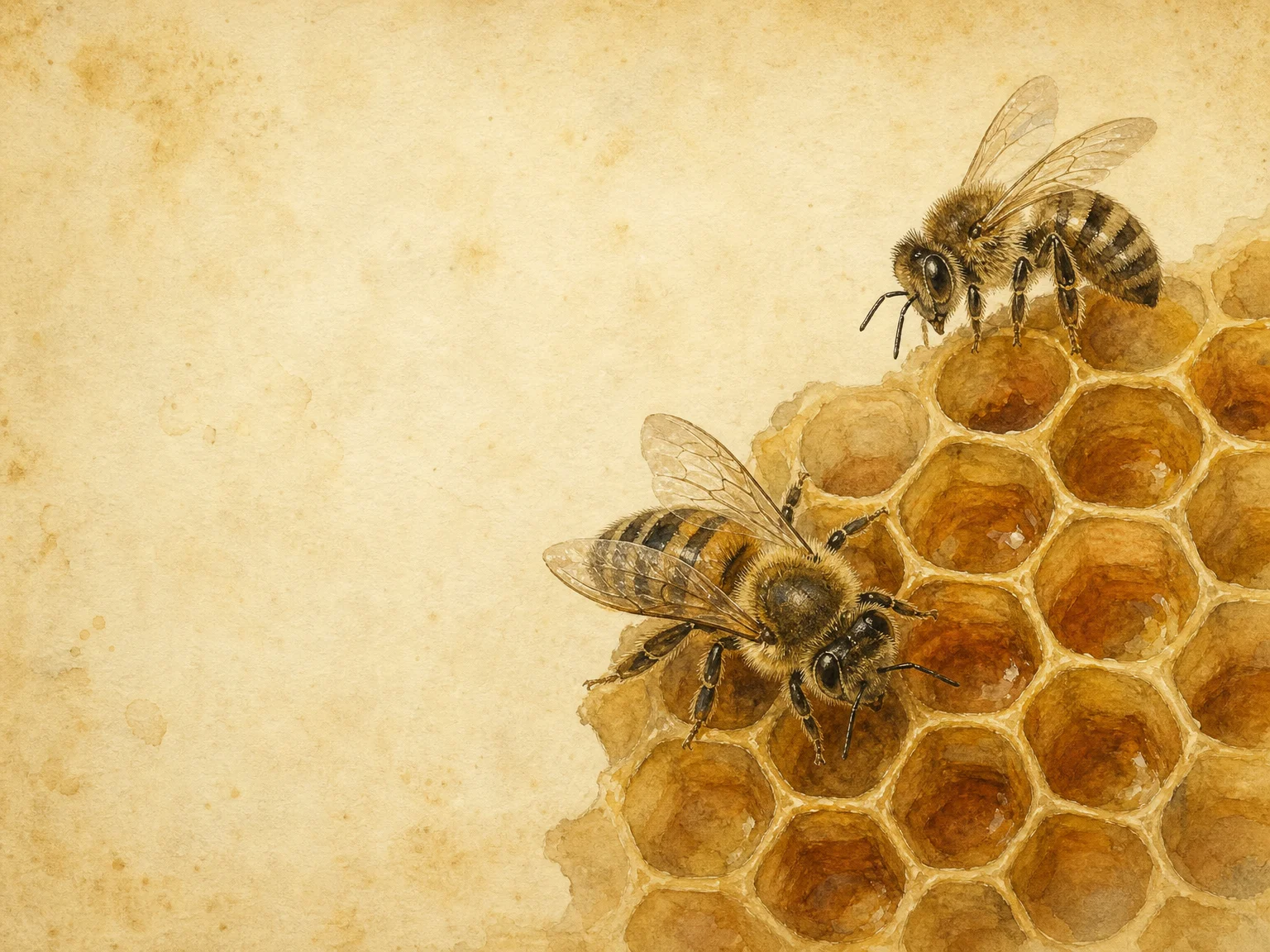
Secreted by Apis mellifera workers from eight sternal wax glands and harvested from honeycomb. The shorter, softer wax that pairs with carnauba to give a hardwax-oil film its silk-matt sheen, its plasticised flex, and its breathability — the same chemistry that has kept Fayum encaustic portraits luminous for almost two thousand years.

Breathable Sealant · Plasticiser

At a glance

The material in one panel.

Botanical name
Apis mellifera L. — wax: Cera Alba (white) · Cera Flava (yellow)
Family
Apidae · honey bee family
Origin
Global beekeeping — India leads world production (FAOSTAT 2018, 25 895 t)
Function in paint
Sealant · breathable wax · plasticiser · sheen and buffability
Melting range
62–65 °C — Tulloch mean 64.3 °C across 80 samples (AOCS, 1972)
Composition
Linear wax esters 35–45 % · complex esters 15–27 % · odd-chain hydrocarbons C27–C33 12–16 % · free fatty acids 12–14 % · free alcohols ~1 % (JECFA Monograph 1)
Food safety status
US-FDA GRAS 21 CFR 184.1973 · EU additive E 901 · INS 901 · JECFA "no safety concern" (TRS 934, 2005)

Origin

The oldest paint medium still in use.

Beeswax — Cera Alba when bleached, Cera Flava when yellow — is secreted by worker honey bees from eight wax-producing glands on the underside of the abdomen, on sternites four to seven. The wax extrudes as a clear liquid that hardens on contact with air into small translucent scales, which the bee then chews and integrates into the honeycomb. About 1 100 scales weigh one gram, a colony consumes roughly 8 kg of honey to produce 1 kg of wax, and comb-building requires a hive temperature of 33 to 36 °C — the wax has to be liquid at the moment of secretion.

The material's history as a paint binder is longer than any other in continuous use. Egyptian preparations are documented from the third millennium BCE, but the defining technical demonstration is the Greek-Roman encaustic tradition: pigments ground into molten beeswax and applied warm to a wooden panel. The Fayum mummy portraits — painted in encaustic on cypress and lime panels between roughly 100 and 300 CE in Roman Egypt — are the largest body of evidence. Around 900 survive; many in the Met, the British Museum, the Art Institute of Chicago and the Brooklyn Museum. Their encaustic specimens have kept colour saturation, luminosity and surface detail for close to two thousand years.

European industrial use of beeswax for candles, polishes and wood preparations is continuous from the medieval period. The modern reasons for keeping the material in a high-end paint recipe are unchanged from the encaustic argument — a wax-bound film breathes, repairs, and survives, qualities a synthetic film cannot match without trade-offs elsewhere.

Fayum portraits painted in encaustic have kept their luminosity for two thousand years — the longest surviving demonstration of a wax-bound paint film.

Chemistry

Why it melts at 64 °C — and why that matters.

Pure yellow beeswax is a complex mixture, not a single compound. The JECFA reference monograph specifies five compositional groups: linear wax monoesters and hydroxy-monoesters at 35 to 45 % with C40–C48 chain lengths derived from palmitic, 15-hydroxypalmitic and oleic acids; complex wax esters 15 to 27 %; odd-numbered straight-chain hydrocarbons 12 to 16 %, predominantly C27–C33; free fatty acids 12 to 14 %, mostly saturated C24–C32; and free fatty alcohols at about 1 %, C28–C35. An average formula is sometimes cited as the palmitate ester of triacontanol, with the ratio of triacontanyl palmitate to cerotic acid running about 6:1 in European beeswax.

The Tulloch et al. work at the NRC Prairie Regional Laboratory in the early 1970s is still the foundational physical-property reference: 80 samples of Canadian yellow beeswax gave a mean melting point of 64.3 °C, acid value 18.7, ester value 72.6 and hydrocarbon content 15.3 %. FAO industrial references converge on 64.5 °C as the practical value.

That melting range — narrow and below human body temperature — is the chemical reason beeswax is the universal pairing partner for harder, higher-melting waxes in floor and furniture finishes. Carnauba and candelilla are several times harder and more abrasion-resistant, but on their own cure into a brittle film that buffs poorly and feels dry underfoot. Beeswax's shorter average ester chain (around C44 versus carnauba's C50) means lower crystallinity, a softer, more plastic film, and a surface that can be re-buffed to a silk-matt sheen with hand pressure.

Why we still use it

The pairing that holds the recipe together.

Carnauba wax gives a hardwax-oil floor its wear layer. Linseed oil gives it the binding backbone that locks pigment and wax into the wood. Beeswax does the third job — the one that decides how the surface looks, feels, and reacts to the next coat in five years.

The first contribution is breathability. Beeswax-bound films leave a film permeable to water vapour but resistant to liquid water. A linseed-oil film alone is already breathable; a fully synthetic urethane film is not. Adding beeswax to a hardwax-oil blend preserves the breathability of the oil while adding hydrophobic surface, so the floor or worktop stays open enough to release trapped substrate moisture but does not absorb spills. The second is buffability and sheen — carnauba on its own cures glassy and hard; beeswax co-melted with it cures softer and lower in crystallinity, so the surface takes a soft cloth and a few minutes of hand pressure into a silk-matt finish.

The third is plasticisation. Beeswax's shorter, more flexible chains co-crystallise with carnauba's longer ester chains and the cross-linking linseed oil, taking brittleness out of the combined film. The Fayum precedent — encaustic portraits in good condition after two thousand years — is the historical proof that wax-bound films do not embrittle catastrophically when the wax is the right one. The carnauba-beeswax-linseed pairing is the canonical hardwax-oil triplet documented across the peer-reviewed wood-coatings literature; Pavlič et al. in Coatings (MDPI, 2021) describe exactly this recipe as the standard.

In LEINOS recipes

Where beeswax sits in the line.

Beeswax appears in two distinct LEINOS product families — the hardwax-oil family (paired with carnauba over a linseed-oil binder) and the water-based decorative-wall family (as a co-emulsified wax-and-soap finish). The hardwax-oil etalon is 290; the decorative-wall etalons are the scumble fillers 630 and 631, both of which name beeswax explicitly in the TDS composition.

Safety · Responsible Use

Natural. Not unconditional.

Beeswax is one of the most extensively cleared natural ingredients in the global food and cosmetic supply chain. The US-FDA affirmed it as GRAS in 1978 under 21 CFR 184.1973, recognising both yellow and white beeswax as flavouring agent, lubricant and surface-finishing agent at GMP levels. In the EU it is food additive E 901 (INS 901), and in 2005 the 65th JECFA concluded that beeswax raises no safety concern at the predicted dietary exposure of less than 650 mg per person per day — an "acceptable" status under TRS 934.

In cosmetics, the CIR Expert Panel reviewed beeswax alongside carnauba, candelilla and Japan wax in 1984, re-affirmed the "safe under present practices" conclusion in 2005, and re-opened the review in February 2025 — covering 8 872 distinct registered products at concentrations up to 35 %. Sensitisation reports exist but are predominantly mediated by propolis cross-reactivity rather than the wax itself: Nyman et al. in Contact Dermatitis (2019) patch-tested 95 cheilitis and facial-eczema patients, and 14 of the 17 beeswax-positive patients also reacted to propolis, confirming the clinical pattern.

  • Food-contact: yes, but check the TDS, not the wax

    The raw wax is FDA-GRAS and EU-listed as E 901. A cured LEINOS hardwax-oil film is not the wax alone — it is wax co-cured with linseed oil, plant solvents and trace driers. For food-contact wood (cutting boards, worktops in food prep) refer to the product-specific TDS — LEINOS Countertop Oil 280 is third-party tested by WESSLING for compliance with EU Regulation 1935/2004 and the German LFGB §31 (certificate CAL24-0568511). Do not assume by ingredient.

  • Comfortable at Indian summer temperatures

    Beeswax melts at 62 to 65 °C — far above any habitable ambient or applied surface in India. A worktop in Delhi summer reaches 45 °C in extreme cases; a sun-baked terrace in Rajasthan rarely exceeds 55 °C. Both stay below the wax's melting threshold. The cured hardwax-oil film remains structurally a solid wax-oil composite with no softening, no migration and no visible bloom.

  • Animal origin — and what that means for sourcing

    Beeswax is an animal product. It is not vegan, and strictly read not vegetarian either, though the European Vegetarian Union accepts honey and wax in lacto-ovo diets. Conventional commercial beekeeping involves practices increasingly contested — routine re-queening with killing of the old queen, wing-clipping to prevent swarming, migratory pollination that USDA-ARS lists among CCD immune-stressors. Demeter Biodynamic and Naturland organic standards prohibit lethal queen replacement and require beekeepers to use organic wax from the colony's own cycle. LEINOS sources from European apiarists under these standards or equivalent organic certification. We name the issue because every architect with a sustainability brief will ask.

  • India: world-leading beeswax producer

    India is the largest beeswax producer in the world. FAOSTAT 2018 figures put national production at 25 895 tonnes — more than any single European or American beekeeping economy. Roughly 80 % of that output comes from Apis cerana indica, the native Asiatic hive bee whose colonies sit smaller and gentler than the European Apis mellifera that supplies LEINOS European apiaries. The two waxes are chemically near-identical — same melting range (62 – 65 °C), same ester-and-hydrocarbon backbone — but the LEINOS supply chain stays on Apis mellifera under Demeter Biodynamic and Naturland organic certification to keep traceability and standard compliance unbroken. The Indian beekeeping base is a strategic option for future sourcing, not the current one.

Got Questions?

Questions about Beeswax?

Quick answers on formulation, application and Indian-climate suitability. Pulled from our full FAQ and TDS library.

No. Beeswax is an animal product, secreted by Apis mellifera worker bees and harvested from honeycomb. By the strictest reading it is not vegetarian either, although the European Vegetarian Union accepts honey and wax in lacto-ovo diets as a matter of practice. For projects with a fully vegan brief, LEINOS hardwax-oil 290 and adjacent oil-wax products are not the right specification. The honest alternative on the LEINOS catalogue is the oil-resin chemistry family (exterior oils such as 236), which uses linseed oil and natural resins with no animal-derived wax. We do not hide the ingredient and we will not relabel an animal-derived material as plant-based.
Talk to us

Specify with confidence.

Need the TDS, a sample, or guidance on which LEINOS product is right for your project?