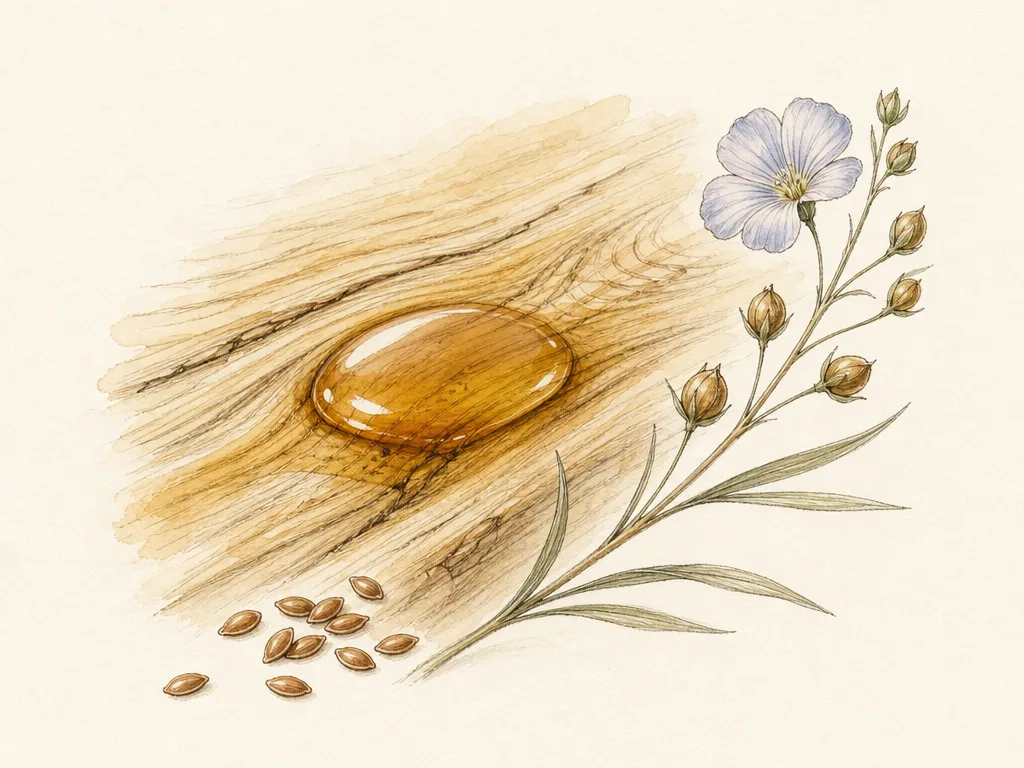
Paint Types · Oil

The finish that lives inside the wood.

A linseed-based penetrating oil soaks into the timber and cures there — no film on top, no peeling edge. A hardwax oil adds natural waxes for a tougher wear layer. It is the LEINOS core finish for floors, furniture, worktops, and exterior decking.

Oil-based wood finish

What it is

What is wood oil & hardwax oil?

Wood oil is a natural penetrating finish built on linseed oil — a drying oil that soaks into the open pores of bare timber and cures by oxidative polymerisation inside the wood fibres rather than forming a film on the surface. The result becomes part of the wood: water-repellent, vapour-permeable, and open-pore, with nothing on top to peel, crack, or trap moisture. A hardwax oil adds natural waxes — such as carnauba — to the linseed base, creating a thin wear layer at the surface of the oil-saturated wood that raises dirt resistance and tolerance of foot traffic. Both leave the grain fully tactile and visible; the wood looks fed, not coated. LEINOS makes four oils for this catalogue: Interior Hardwax Oil 290 for floors and interior wood, Countertop Oil 280 for food-contact kitchen surfaces, Hard Oil 240 as a multi-purpose penetrating base, and Terrace Wood Oil 236 for exterior decking and outdoor timber.

Finish type
Penetrating oil · no surface film
Primary binder
Linseed oil (drying oil — cures inside the wood)
Hardwax variant
Linseed base + natural waxes (e.g. carnauba) for a wear layer
Surface character
Open-pore · vapour-permeable · tactile grain
VOC content
360–440 g/l depending on product (within EU limits · Directive 2004/42/EC)
Coverage
Approx. 130–320 sq ft per litre per coat (product- & surface-dependent)
Drying (290 / 280)
Touch-dry approx. 6–12 h · recoatable approx. 12 h · full cure approx. 7–10 days
Coats
At least two
Food contact
Countertop Oil 280 — EN 71-3 migration-tested, after full cure
Use
Interior floors, furniture, worktops · exterior decking (236)
Reference product
LEINOS Interior Hardwax Oil 290 · Made in Germany

The mechanism

Penetration, not coating.

Linseed oil is a drying oil — it cures by absorbing oxygen and polymerising into a solid network, not by evaporating a solvent. Applied thinly to bare, absorbent timber, capillary action draws the liquid oil into the pores and cell walls. As it cures, the oil becomes structurally part of the wood: it does not sit on top as a glassy layer but consolidates the timber from within, making the surface water-repellent and more wear-resistant.

A hardwax oil adds natural waxes to that linseed base. The waxes stay nearer the surface of the oil-saturated wood, forming a thin, continuous wear layer harder than bare oil — which is why a hardwax oil (LEINOS 290) is the specified finish for floors under heavy foot traffic: the wax takes the daily abrasion while the oil base keeps the timber consolidated.

The open-pore structure is the defining difference from a varnish. No film is built, so water vapour moves freely and the timber can breathe. When wear eventually scratches a hardwax-oiled floor, the damage is a surface scuff in the wax layer, and the repair is a localised re-oil of that patch — not a full strip and recoat of the whole floor.

The oil cures inside the wood. The surface you touch is wood — oiled wood.

India context

Why penetrating oil suits Indian timber and climate.

Indian high-value hardwoods — teak, sheesham, mango wood, sal — are dense and oily. A penetrating oil works with that density: it feeds the timber’s own oils and stabilises the wood against India’s extreme humidity swing between monsoon and dry season, rather than sealing the surface and trapping the movement stress behind a rigid film. The surface ages as patina, not as peeling.

For kitchen worktops — common in open-plan Indian homes and café fit-outs — LEINOS Countertop Oil 280 addresses food safety directly: the TDS states it is migration-tested to EN 71-3 and ready for food contact once fully cured (approximately 7 days), which makes it the correct specification for solid-wood counters, butcher blocks, and shared dining tables.

Exterior decking faces a harder test in India than in most European climates: tropical UV, monsoon saturation, then a dry season. LEINOS Terrace Wood Oil 236 is the penetrating exterior answer — it keeps an open-pore, vapour-permeable structure so the wood dries out after rain rather than trapping moisture under a film, and maintenance recoats need no sanding because the oil simply re-penetrates the existing surface.

At a comparison

Penetrating oil vs film-forming varnish

Both finish wood. The mechanism differs in every way that matters for maintenance, feel, and long-term wood health.

PropertyPenetrating / hardwax oil (LEINOS 290)Film-forming varnish
MechanismSoaks into the wood, cures inside — no layer on topBuilds a resin film on the surface
Surface feelTactile grain, matt-to-satin — you feel the woodSmoother, more closed — you feel the film
Vapour permeabilityOpen-pore, vapour-permeable (290 TDS)Closed film — restricted vapour movement
RepairabilitySpot-repair: re-oil the worn area onlyRe-sand and re-coat to repair visible damage
Wear mechanismWax layer wears first; oil base stays in the woodFilm wears through to bare wood once broken
VOC content440 g/l (LEINOS 290 — EU limit 500, Cat. i)Varies; solvent-borne types commonly higher

LEINOS figures are from the 290 Technical Data Sheet. The varnish column is qualitative — performance and VOC vary by product; always read the specific TDS.

Safety · Responsible Use

Natural oils. One real hazard.

Linseed-based oils cure by oxidation — they react with oxygen from the air, and that reaction generates heat. A rag soaked in oil has a very large surface area, so in a confined space with poor air circulation the heat cannot dissipate and the rag can reach ignition temperature on its own. This is a documented, real risk for all the oils in this category, and the LEINOS TDS states it explicitly: oil-soaked rags and residues may spontaneously combust. After use, lay rags flat outdoors to dry completely, or submerge them in a sealed metal container of water until disposal.

Beyond the rag risk, these are solvent-containing products (aliphatic hydrocarbons): ventilate well during application and drying. The 290 and 280 TDS require ambient and surface temperature above 15 °C; the 236 TDS requires above 10 °C. The full hazard register is on each product’s Safety Data Sheet, available from LEINOS India.

  • Spontaneous combustion — mandatory precaution

    Oil-soaked rags, cloths, and pads must be handled after use: lay them flat in open air to dry fully, or submerge in water in a sealed metal container. Never fold or pile them — confined heat has no escape route. This is stated in every LEINOS oil TDS.

  • Ventilate during drying

    Aliphatic hydrocarbons require adequate ventilation during application and drying. Keep windows open. Minimum substrate and ambient temperature is 15 °C for 290 and 280, and 10 °C for the 236 exterior oil.

  • Food contact — 280 only, after cure

    Only Countertop Oil 280 is migration-tested for food contact (EN 71-3). Allow full cure — approximately 7 days — before placing food or kitchen items directly on the surface. The other oils are not specified for direct food contact.

Got Questions?

Questions about wood oil & hardwax oil?

Quick answers on formulation, application and Indian-climate suitability. Pulled from our full FAQ and TDS library.

Wood oil is a natural penetrating finish built on linseed oil — a drying oil that soaks into bare timber and cures by oxidative polymerisation inside the wood fibres, rather than building a film on top. A hardwax oil is the same linseed base with natural waxes (such as carnauba) added: the waxes form a thin, harder wear layer at the surface for better protection under foot traffic. Both leave the wood open-pore and vapour-permeable — the surface is still wood; you feel the grain, not a coating.
Talk to us

Specify with confidence.

Need the TDS, a sample, or guidance on which LEINOS product is right for your project?

Written by the LEINOS India technical team, in collaboration with
Reincke Naturfarben R&D, Lower Saxony.

Last updated