



0.25L
Covers
70–90 sq ft
1 coat, oiled timber
Best For
A glass bottle, not a tin. For a worktop, a stair run or a patch test
INTERIOR FLOOR CARE · ART. 285
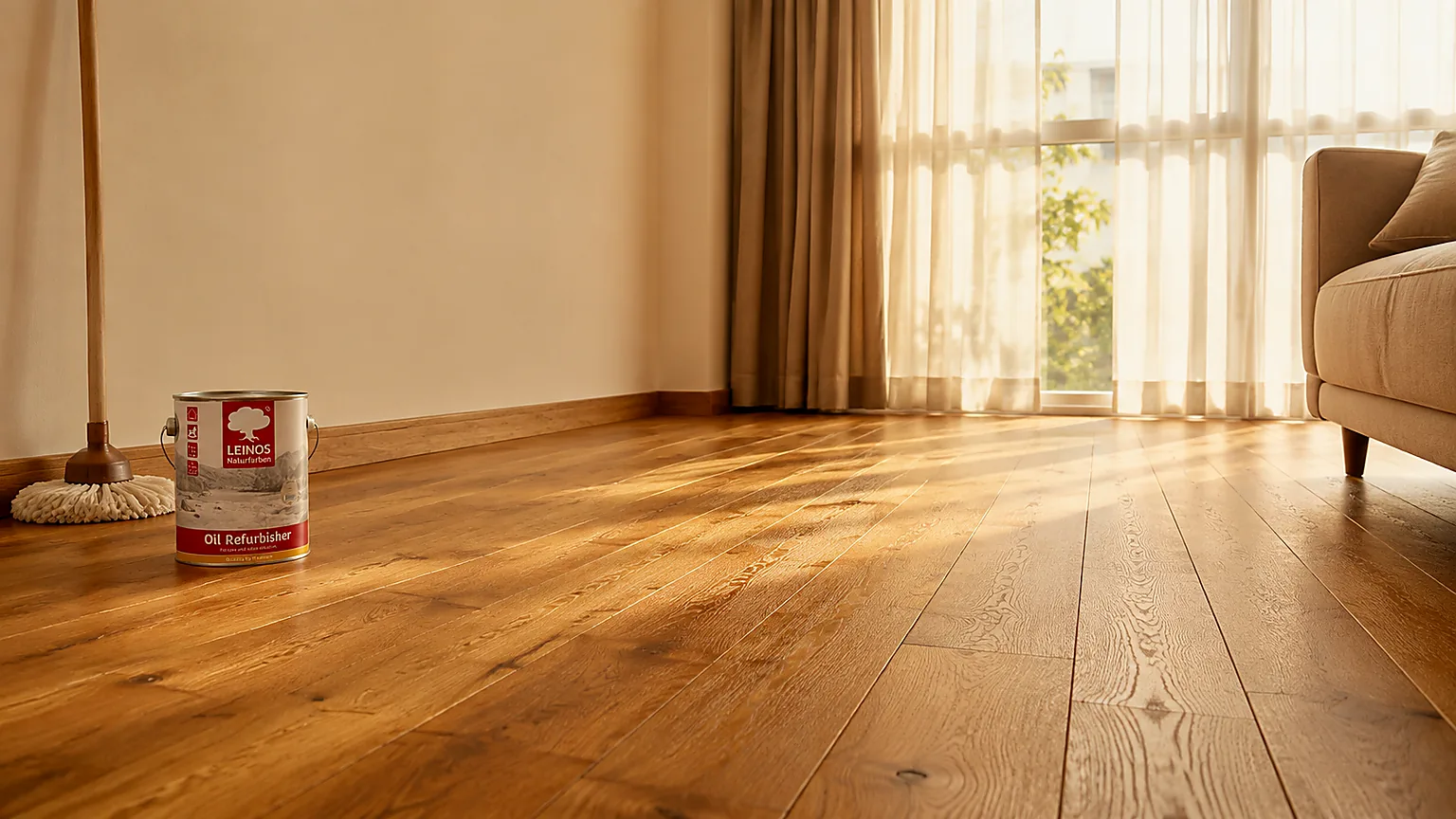
LEINOS 285 is the cleaning-and-care oil for oiled and waxed floors indoors: timber, cork and linoleum. Worked in as an oil wash, it carries years of ground-in dirt out of the boards instead of sanding them off, dust-free and repeatable. Made in Germany by Reincke Naturfarben.
Two Variants
The same care oil in two executions. Colourless renews the tone the floor already has. White carries fine mineral pigment, for limed, whitened and pale floors that a clear oil would deepen.
285.002
Colourless
285.202
White
Neither variant is a paint. Both are transparent care oils: the grain, the tone and the wear of the timber underneath keep showing through. What you see above is each variant worked into an oiled oak board — your own floor will read differently. Test on an offcut or in a corner first.
Choosing between them
On a floor finished with a clear or natural oil, take 285.002. On a limed, white-oiled or deliberately pale floor, take 285.202 — the clear oil would pull those boards warmer and darker. Not sure which your floor is? Send us a photograph and we will tell you.
Mechanism & Use
A drying-oil care oil cut with mineral filler and micro-wax: it rebuilds the finish from inside the pore and carries the dirt out with it, instead of taking the surface off.
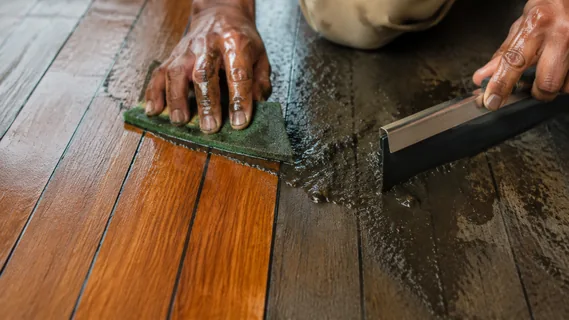
Spread at oil-wash rate, the fresh oil softens and floats the grime that has worked into an oiled floor over the years. A green pad breaks it loose, a squeegee draws it off, and the dirt leaves suspended in the oil — the boards are never abraded.
Sanding removes timber, and a floor can only be sanded so many times before the boards are spent. An oil wash removes soil. It can be repeated as often as the floor needs it, for as long as the floor lasts.
The drying oils cure with atmospheric oxygen and rebuild the finish from inside the pore. Zinc oxide, kaolin, talc and micro-wax give the dry film its silk-matt, water-repellent, hard-wearing surface.
The finish stays open-pored: the oil cures inside the pore rather than as a skin over it, so there is nothing sitting on top to peel or craze at the edges. Because nothing in the formulation is biocidal, the DIN EN 71-3 element-migration and DIN 53160 saliva tests genuinely apply here.
Where It Lives
Oiled timber floors
The core case: plank, strip and parquet floors already finished with a penetrating oil.
Traffic lanes
The dark worn paths that form along the routes people actually walk — the reason this product exists.
Cork flooring
Same oiled-surface logic, same method, same rates.
Linoleum
Named explicitly in the TDS. An oiled care routine, not a polish.
Oiled staircases
Worked by hand throughout — treads and edges are never machine-worked.
Furniture and worktops
Small oiled surfaces where a full refinish would be disproportionate.
Compliance · DIN · EU
Five anchors — including the one number we are not going to dress up.
Element migration
Tested for the migration of elements, the standard written for surfaces children touch.
Skin contact
Resistant to saliva and perspiration once cured, so it does not release into skin contact.
Solvent content
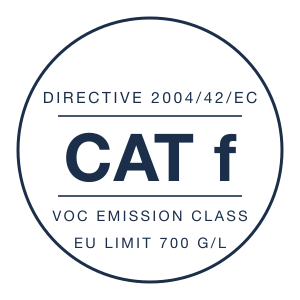
Under the 700 g/l Category f limit, but high in absolute terms. This is a solvent-borne oil and it needs ventilation.
Ingredient disclosure
Every ingredient is published, including the isoparaffin carrier that gives this oil its VOC figure.
Origin
Manufactured by Reincke Naturfarben in Horneburg, to the same formulation sold in Germany.
No biocide is used in either variant, which is why the EN 71-3 and DIN 53160 tests apply here at all. The VOC figure is high and we state it plainly: this is a solvent-borne care oil, not a water-based one, and it needs ventilation while it dries. The TDS is downloadable; the safety data sheet is issued on request — use Talk to LEINOS above.
Read The Full TDSStep by Step
Clean and neutralise. The floor must be dry (wood moisture max. 14 %) and free of dirt and grease. Damp-wipe with LEINOS Vegetable Soap 930, rinse with clean water and let the floor dry through. Floor temperature at least 16 °C.
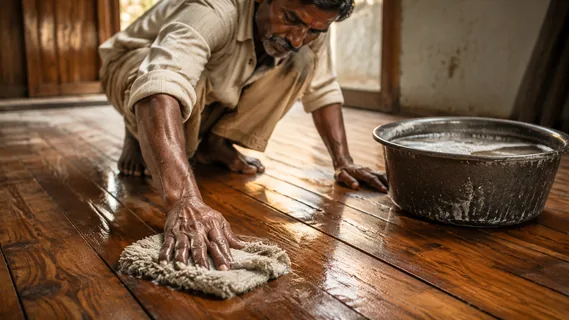
Stir the tin thoroughly, because the mineral filler settles. Ventilate the room throughout: this oil cures with atmospheric oxygen, and a fan helps in stagnant air, which also keeps the odour down.
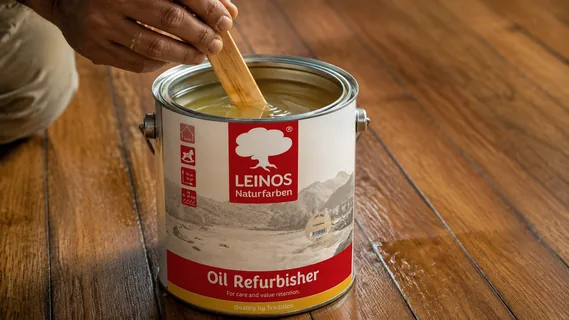
Apply thin and evenly with a short-pile floor mop, at roughly 30–40 ml/m². Thin is the whole technique: this is a care coat that feeds the finish, not a build coat that sits on it.
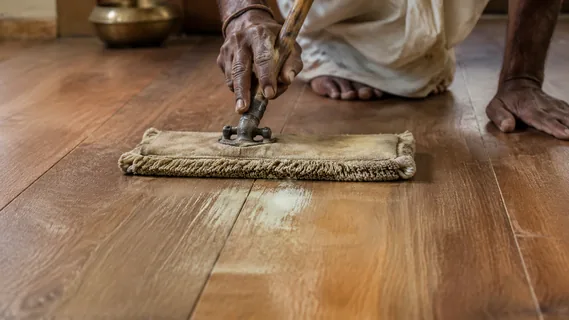
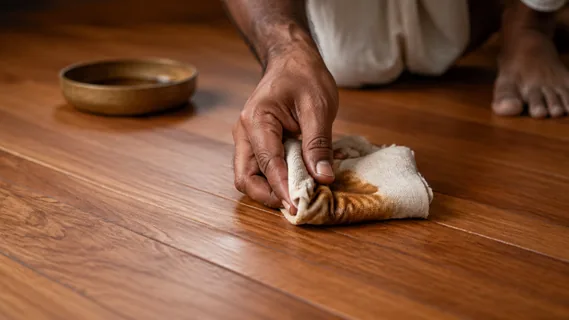
After 15–20 minutes, lift every trace of surplus with a lint-free cloth. Oil left standing will stay tacky. Badly worn, faded and dry boards take a second pass.
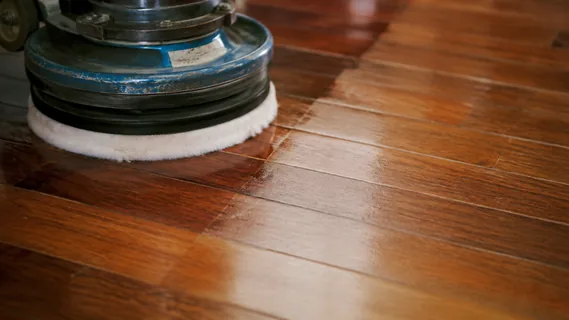
Polish under a white pad to an even satin sheen. Dry, sandable and recoatable after 6–12 hours at 20 °C and 50–55 % humidity; walk on it with care after 1 day; full use after 7–14 days.
Or run the full oil wash. For a floor with years of grime in it: 100–200 ml/m², worked with a green pad and drawn off with a rubber squeegee. The same slurry does two to three adjacent sections before it is spent. Finish the whole room under a clean white pad until nothing stands, and after about 24 hours a drop-thin pass under a white polishing pad evens out the sheen.
Coats & Recoating
Cleaning & Storage
First time with Oil Refurbisher? Our technical team runs complimentary on-site walkthroughs for contractors — full application protocol, start to finish.
System & Substrates
A care oil has no primer. What it has is an order of work, and a machine that does the heavy part.
The Care System
Soap takes the surface dirt off. The oil wash takes out what the soap cannot reach. Floor Milk keeps it there between washes.
Long-term Care
Extends the life of the finish over the years.
Substrate Fit
Suitable
Honest Limits
Use With Care
Coverage & Pack Sizes
Two modes, two rates. Routine care runs at 30–40 ml/m²; the oil wash needs 100–200 ml/m², depending on how absorbent and how dirty the floor is. Budget three to five times the maintenance figure for a first deep clean, and remember the slurry is reused across two or three sections before it is spent.
0.25L
Covers
70–90 sq ft
1 coat, oiled timber
Best For
A glass bottle, not a tin. For a worktop, a stair run or a patch test
0.75L
Covers
205–270 sq ft
1 coat, oiled timber
Best For
One room’s traffic lanes
2.5L
Covers
675–900 sq ft
1 coat, oiled timber
Best For
A flat’s worth of routine care
10L
Covers
2700–3600 sq ft
1 coat, oiled timber
Best For
A full oil wash, or a contractor working several floors
Enter your area to see how much material — and the most efficient pack mix — you’ll need for 1 coat.
Full calculatorFull Declaration
Every ingredient declared on the label. The Trust Hub explains what each one does and the standards behind it.
The drying-oil base, pressed from flax. It penetrates into the pore and cures by taking up atmospheric oxygen, which is why this system needs ventilation rather than heat to dry.
Wood Oil (Tung)
Tung oil, from the nut of the tung tree. It cures harder and more water-repellent than linseed alone, which is what lets a care coat stand up to foot traffic instead of remaining soft.
Castor Oil
A co-binder that keeps the cured film flexible. A floor moves with the seasons, and a brittle care coat would powder out of the pore within a year.
Natural Resin Ester
Rosin ester, from pine. It cross-links with the drying oils and gives the finish its body and its resistance to marking.
Isoparaffins
The carrier that makes the oil thin enough to spread at 30–40 ml/m² and to be worked with a pad. It flashes off as the oil cures, and it is the reason the VOC figure is 660 g/l, which we publish rather than bury.
Mineral Fillers & Micro-Wax
Zinc oxide, alumina, kaolin, talc, silica and micro-wax. Together they give the dry surface its silk-matt sheen, its water repellency and its resistance to wear. In 285.202 White, mineral pigments join them.
Driers
Catalysts that bring the oxidative cure into a working timescale: dry in 6–12 hours rather than weeks. No biocide is used anywhere in either variant.
Got Questions?
Quick answers on formulation, application and Indian-climate suitability. Pulled from our full FAQ and TDS library.
For Architects & Specifiers
Technical and safety documents — citable in project specifications.
Need a Recommendation?
Four ways to reach our India team — pick the one that fits how you work.
For Trade & Specifiers
Full TDS / SDS library, specification support and trade pricing — direct from the manufacturer.
Documents
TDS / SDS
Per-product datasheets and safety sheets, downloadable in English.
Specification
NCS Match
Custom colour briefs and material samples mixed at our Delhi lab.
Trade
Direct Pricing
Volume tiers, project quoting and stock allocation through our trade desk.
Written by the LEINOS India technical team, in collaboration with
Reincke Naturfarben R&D, Lower Saxony.
Last updated
Want to represent LEINOS in your city?
Become a Dealer