Origin
The tree of life of the Brazilian Northeast.
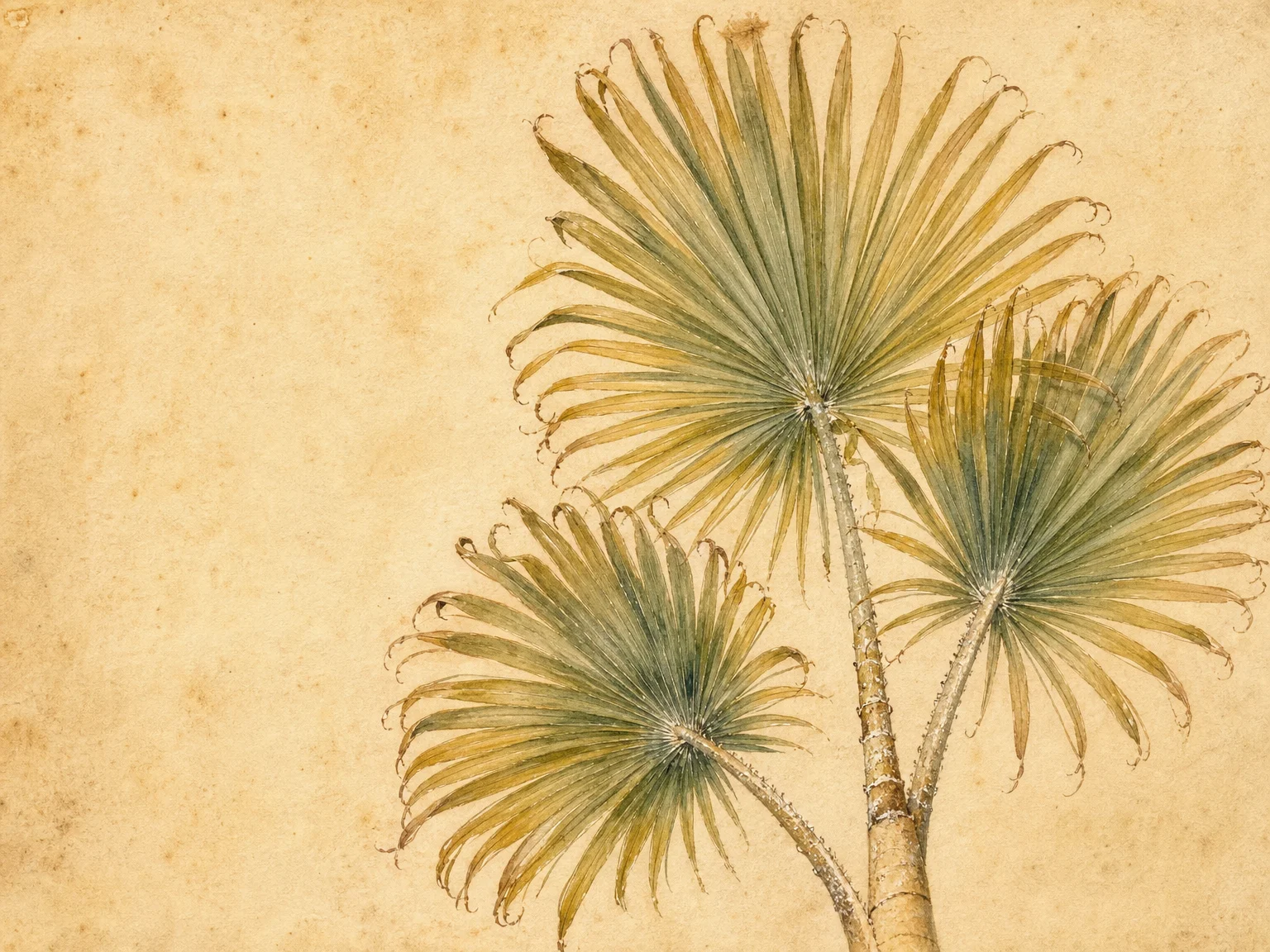
The carnauba palm — Copernicia prunifera, family Arecaceae — is endemic to Brazil, growing along the river valleys of the semi-arid Northeast: Piauí, Ceará, Rio Grande do Norte and Maranhão. The plant's defining trick is a layer of fine wax secreted on the underside of its fronds during the dry season, a survival mechanism that prevents transpiration loss under 40 °C heat. Piauí and Ceará account for roughly 96 % of national wax production today, and together with neighbouring states the industry sustains an estimated 100 000 to 200 000 seasonal harvesters.
Long before commercial export, the carnaubeira was used by indigenous and sertanejo communities for almost every part of the plant — fruit as food and fodder, fibre for rope and roofing, stem for construction, roots in folk medicine. The German naturalist Alexander von Humboldt, travelling through Brazil in the early nineteenth century, called it the "tree of life" for this multiplicity of uses — a name that has stuck in Brazilian ethnography and is repeated by the IBGE and Britannica to this day.
European industrial interest began around 1810 to 1850, when British and French chemists confirmed the wax's exceptional hardness and melting point — first for candles, then from the late nineteenth century onwards as the workhorse component of floor and shoe polishes. The trade has run continuously for over 150 years, making carnauba one of the longest-running export commodities of the Brazilian Northeast.
The tree of life of the Brazilian Northeast — a name older than the export trade itself.