Vegetable Soap
Fat-replenishing cleaner for oiled, waxed, and lacquered surfaces. Universal cleaning product from plant-based renewable raw materials.
View product detailsCare & Maintenance · Solutions
A teak dining table in a Bengaluru flat that hosts every meal, a sheesham desk in the work-from-home corner, a Mumbai wardrobe carrying the family's clothes through six monsoons — interior oiled furniture earns its life in daily contact with hands, glasses, plates, dust, jhadu-pochha cycles, and the humidity swing between Indian summer (RH 30%) and monsoon (RH 85%). Maintenance is a partnership with the finish, not a fix applied to it.
Find your application
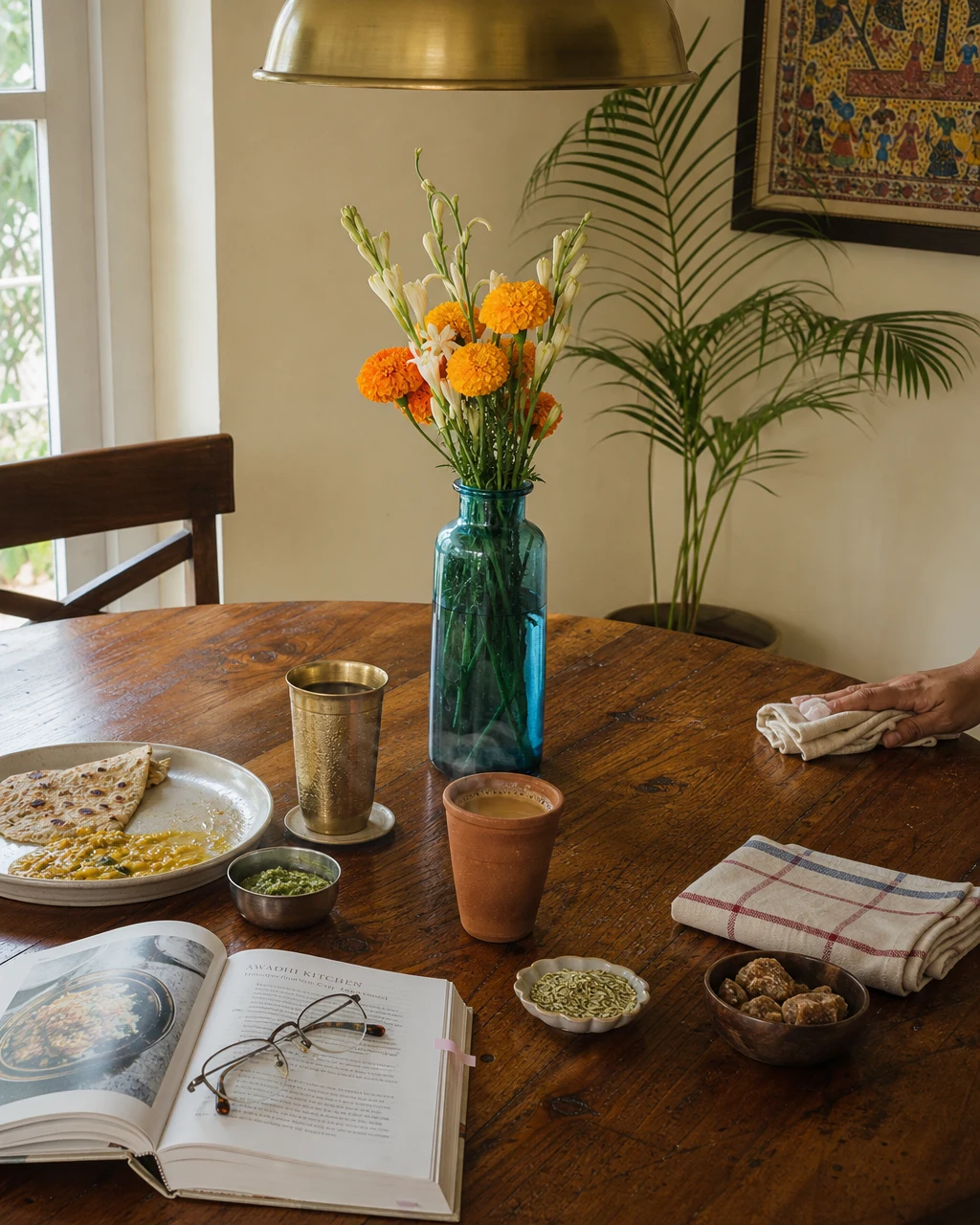
Horizontal surfaces in daily contact — dining tables, work desks, study tables, breakfast counters in oiled wood (sheesham, teak, Burma teak, mango). The most-loaded surface in the home — every meal, every laptop session, every chai mug leaves a mark. Routine: Vegetable Soap 930 weekly wipe (turmeric splash + ginger juice + chai-spill reality), Furniture Polish 910 monthly to restore satin and water-bead, Oil Refurbisher 285 yearly when water no longer beads on the dining zone. Indian household reality: wipe spills within minutes — hardwater rings on a dining top set within an hour.
3 compatible productsFat-replenishing cleaner for oiled, waxed, and lacquered surfaces. Universal cleaning product from plant-based renewable raw materials.
View product detailsCare product for oiled and waxed furniture surfaces. Provides water-repellent, deep-penetrating impregnation for naturally treated interior surfaces.
View product detailsCleaning and care oil for oiled and waxed wood, cork, and linoleum floors. Prevents traffic lane formation while maintaining open-pore finish.
View product detailsSystem & Substrates
For initial oiling or refinishing of bare wood, see the Interior Furniture & Cabinets solution.
The Coating System
Primer plus topcoat — the full chain.
Long-term Care
Extends the life of the finish over the years.
Step by Step
Dilute 30–50 ml of 930 in a 10 L bucket of lukewarm water (roughly two tablespoons of soap per full mopping bucket — staff-trainable dosing). Wipe the dining or desk top with a well-wrung cotton cloth in grain direction, then dry-buff with a separate clean cloth. Never leave standing water on the surface; never use a soaking-wet pochha cloth. Pay attention to the eating zone, the front-of-desk arm-rest area, and the chai-mug corner.
Turmeric splash, ginger juice, chai spills, lemon rind contact, hot kadai condensation, and especially hardwater glass-rings all set within an hour on an oiled top. Train the household: any spill gets a quick 930-and-water wipe within minutes, dry-buff after. The 910 monthly polish and 285 yearly refresh both work better on a top that has not accumulated set-in stains week-after-week.
Pour a small amount of 910 onto a clean soft cotton cloth (shake the bottle first). Apply thinly in the direction of the wood grain, covering the whole top — eating zone, edge profile, end-grain at the corners (absorbs more). After 5–10 minutes of penetration, buff vigorously with a second clean dry cloth until the surface is dry to touch and satin returns. No rinse, no excess to wipe — the polish is engineered to be ready-to-use and self-absorbing.
Once a year (suggest pre-Diwali household round), drip a few drops of plain water across three zones of the top — eating zone, middle, edge. If the drops bead and roll, the finish is intact and the 930-weekly + 910-monthly cadence is enough. If the drops sit flat or the wood visibly darkens under the drop within 30 seconds, that zone is due for 285 refresh.
Clean the top thoroughly with 930 first, rinse with a damp clean cloth, allow to dry fully (1–2 hours). Apply 285 thinly with a soft cloth or short-nap mop in grain direction — sparingly, the finish absorbs what it needs. After 15–20 minutes, wipe excess vigorously with a clean dry cloth and polish back to dry. The top is light-handling ready after 24 h.
285 full polymer cure is 7–10 days. During this window: no heavy plate-and-glass meal load on the refreshed surface, no hot dishes directly on the top (use trivets), no hardwater ring exposure (wipe drips immediately). For a dining table that gets used every meal, schedule the 285 refresh on a long weekend or before a travel break — the household needs a soft week of use.
System Composition
Why It Works
Pick the Right Build
930 weekly wipe (30–50 ml per 10 L), 910 monthly polish, 285 yearly refresh on the eating zone (the centre wears first). Suggest scheduling the 285 refresh pre-Diwali when the household is doing a deep-clean round anyway.
930 weekly + 910 monthly + 285 yearly
930 weekly wipe with focus on the front arm-rest zone and the chai-mug corner, 910 monthly polish, 285 every 18–24 months (desk wear is slower than dining wear). Pay attention to the keyboard zone — light P320 sand + 285 spot refresh if the finish has worn through there.
930 weekly + 910 monthly + 285 every 18–24 months
930 every 2 weeks (lower intensity), 910 every 6 weeks, 285 every 18–24 months. Trained staff can run the cleaning cadence on a fortnightly mopping round; the polish is owner-supervised once a month or so.
930 fortnightly + 910 every 6 weeks + 285 every 18–24 months
Same cadence as warm hardwoods. Note: 910 polish slightly warms pale wood over many years (linseed-based). For a strictly non-yellowing care path, refresh with the original Hard Oil Clear 241 instead of 285 — coordinate with the original finishing product.
930 weekly + 910 monthly + 241 refresh (instead of 285)
What to Expect
What to Avoid
Scope & Limits
This solution applies to maintenance of interior oiled wood furniture — dining tables and desks, study and console tables, side and coffee tables, bookshelves and open shelving, wardrobes and chests of drawers, sideboards and consoles, chairs, frames, legs, and similar freestanding or built-in joinery treated with LEINOS interior oils (Hard Oil 240, Hardwax Oil 290, Hard Oil Clear 241, Hard Oil Universal 259).
In the wild
Common Questions
Next step
Move into the filtered catalogue, or jump back to surface choice if you're still scoping the project.
Adjacent applications
Need a Recommendation?
Four ways to reach our India team — pick the one that fits how you work.