Care & Maintenance · Solutions

Care: Interior Oiled Floors

A teak plank floor in a Bengaluru living room, a sheesham parquet in a Mumbai bedroom, a Burma teak staircase landing in a Pune bungalow — an oiled wood floor is part of a slow conversation with the household. Slipper traffic, jhadu-pochha after breakfast, monsoon humidity sliding from 35% RH to 85%, the occasional spilt chai — none of it damages an oiled finish if the maintenance routine matches the wear. This page sets out that routine in three layers: daily quick-clean, weekly or monthly deep-wash, and the once-a-year (or once-every-two-year) refresh coat.
InteriorSingle Layer3 compatible products
  • Gentle on the oil finish — no stripping
  • Restores worn traffic lanes without sanding
  • Bonds with the finish — partnership, not a fix
  • Three routines on a daily / weekly / yearly cycle
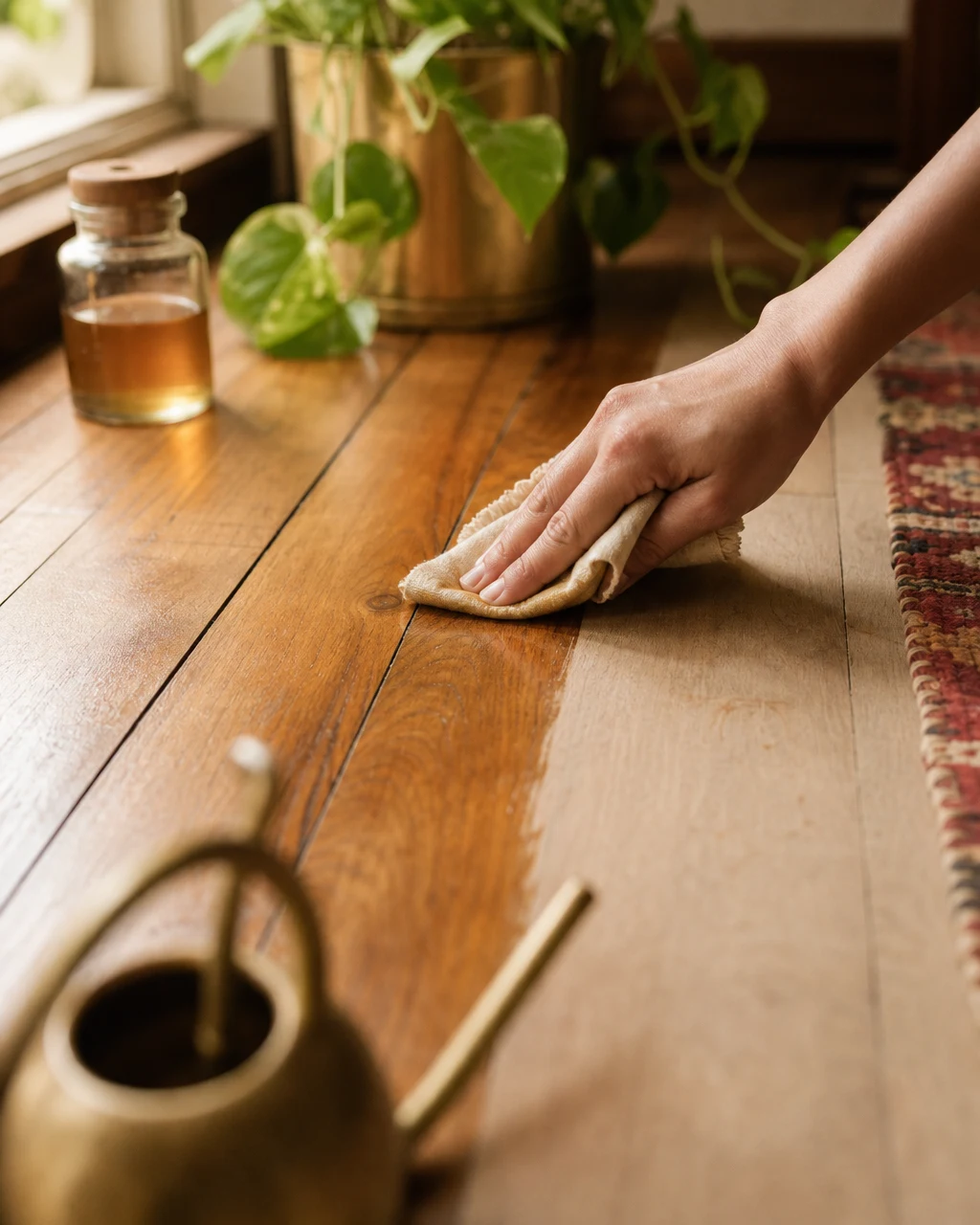
Hand-and-cotton-cloth gesture polishing an oiled teak plank floor mid-room — half the visible section freshly cared for (deeper amber), half awaiting (paler matte), a brass watering can in foreground, dhurrie corner

Find your application

Pick the substrate. We'll show what fits.

The diagnostic-triggered refresh coat. When the water bead test fails in the traffic lane — sofa-to-kitchen arc, entry hall, dining-table footprint, stair-tread nosing — Oil Refurbisher 285 goes back on the worn zone in a thin coat. Penetrates into the existing oil finish, no sanding, no stripping. Walkable after 24 h, full cure 7–14 days. Cycle: every 12–18 months on ground-floor living areas in Indian homes, 24–36 months on upper-floor bedrooms. Spot or full-room.

3 compatible products

Floor Milk

Care product for oiled, waxed, and lacquered wooden floors containing natural waxes. Provides antistatic properties and silky-gloss finish without polishing.

View product details

Vegetable Soap

Fat-replenishing cleaner for oiled, waxed, and lacquered surfaces. Universal cleaning product from plant-based renewable raw materials.

View product details

Oil Refurbisher

Cleaning and care oil for oiled and waxed wood, cork, and linoleum floors. Prevents traffic lane formation while maintaining open-pore finish.

View product details

System & Substrates

Three care products, three routines. The floor picks the cadence via the bead test.

For furniture and cabinet care use Furniture Polish 910 instead of Floor Milk 920; for exterior decking and garden furniture use Anti-Greying Fluid 940 + Terrace Wood Oil 236.

The Coating System

Primer plus topcoat — the full chain.

Long-term Care

Extends the life of the finish over the years.

Step by Step

How to Apply

  1. Run the bead-test diagnostic across the room

    Drip water on the sofa-to-kitchen arc, the dining-table footprint, the entry-hall mat zone, and the stair-tread nosing. Where water beads for 60+ seconds the finish is intact (skip 285 on that zone). Where the bead collapses within 30 seconds and the wood darkens, mark the zone — that is where 285 goes. Typically the sofa-arc and entry-hall fail first; perimeter and corners last.

  2. Deep-wash prep on the worn zones with Vegetable Soap 930

    Sweep with jhadu. Fill a 10 L bucket with warm water + 30–50 ml (1 full bottle cap) Vegetable Soap 930. Mop the marked zones thoroughly with a well-wrung microfiber mop — work along the grain, never drag dirty water across clean wood. Dry-cloth wipe immediately after. Let the floor dry fully overnight before applying 285. Floor must be visibly dry and at minimum 16°C.

  3. Shake and decant Oil Refurbisher 285

    Shake the 285 bottle well — the linseed + micro-wax formulation needs re-emulsifying after storage. Decant a small puddle (200–300 ml) on the worn arc. Spread thinly with a short-pile floor mop or a folded cotton cloth — coverage is approximately 270–360 sq ft per litre for this refresh application. Work in 1 m sections along the grain.

  4. Wipe excess at 15–20 minutes — no oil layer on the surface

    After 15–20 minutes of penetration, take a fresh clean cotton cloth and wipe the entire refreshed zone dry — no oil film must remain on top. The 285 has soaked into the existing finish; surface oil that did not penetrate becomes a sticky residue that attracts dust during cure. On stair-nosings, do a second wipe-back at 30 minutes — the vertical face holds excess longer.

  5. Cure window — keep the room quiet

    Walkable in soft cotton socks after 24 h, normal foot traffic after 48–72 h, full polymer cure 7–14 days. During the first 7 days: no rugs back on the refreshed zone (the oil needs air contact to cure), no plate-and-glass drops, no pet claws if avoidable. Ventilate with cross-breeze in dry weather; during monsoon, use fans rather than opening to wet air. Floor temperature minimum 16°C throughout.

  6. Resume the daily-and-weekly rhythm at week 2

    After the cure is complete, resume daily Floor Milk 920 or diluted Vegetable Soap 930 quick-clean and the weekly/monthly deep-wash. Run the bead test again at month 3 to confirm the refresh held. If the same zone fails again within 6 months, the underlying oil layer has worn through into bare fibre — at that point a full re-finishing (Hard Oil 240 + Hardwax Oil 290 from Interior Floors & Stairs) is the next step, not another 285 cycle.

System Composition

  • Bead-test diagnostic on the suspected worn zones — sofa arc, dining footprint, entry hall, stair-nosing
  • Deep-wash prep with Vegetable Soap 930 concentrated (30–50 ml per 10 L), dry overnight
  • Oil Refurbisher 285 thin coat with short-pile floor mop or folded cotton cloth — wipe excess after 15–20 min
  • Cure window: walkable 24 h, normal foot traffic 48–72 h, full polymer cure 7–14 days, floor temperature ≥ 16°C

Why It Works

  • Oil Refurbisher 285 penetrates into the existing oil finish rather than forming a separate film layer. The refresh integrates seamlessly with the original Hard Oil 240 or Hardwax Oil 290 treatment — no visible patch line between the refreshed zone and the surrounding floor, no edge-lift, no peeling.
  • The water bead test on a marked zone (sofa arc, stair nosing) is the cleanest field diagnostic — it isolates the worn area before applying 285, so the refresh is targeted, not whole-room. On most Indian ground-floor living areas, a spot-refresh on 30–40% of the floor area is enough; the perimeter does not need 285.
  • Floor Milk 920 must NOT be present during the 285 refresh — the carnauba-wax layer interferes with 285 penetration. The deep-wash with 930 in step 2 strips the wax film cleanly; 920 resumes only at week 2 once 285 has cured.

Pick the Right Build

Which build fits your surface?

Default ground-floor refresh (sofa arc + entry hall, 12–18 month cycle)

Bead-test fails on the sofa-to-kitchen arc and entry-hall mat zone. Deep-wash these zones with 930 concentrated, dry overnight. Apply 285 thin coat to the marked arc + entry (typically 60–80 sq ft). Wipe excess at 15–20 min. Cure 7–14 days.

Oil Refurbisher 285 spot refresh — 60–80 sq ft on a 200 sq ft room

Upper-floor bedroom refresh (24–36 month cycle, full-room or skip)

Upper-floor bedrooms rarely fail the bead test on individual zones — when one zone fails, usually the whole room is due. Deep-wash whole room with 930, dry overnight, apply 285 thin coat to the full floor. Less frequent than ground floor but covers more area when it runs.

Oil Refurbisher 285 full-room refresh — every 24–36 months

Stair-tread nosing refresh (18–24 month cycle, partial)

The stair-tread nosing wears 2× faster than the tread centre. Bead-test the nosing edge specifically — when it fails, refresh nosings only (not full treads), then schedule full-tread refresh on the next cycle. Wipe-back at 30 min instead of 20 — vertical face holds excess longer.

Oil Refurbisher 285 on stair nosings only — partial refresh every 18–24 months

Full-room refresh after harsh-cleaner damage (post-Lizol recovery)

If Lizol, Domex, or phenyl has been used for months and the bead test fails room-wide, the oil finish is largely stripped. Deep-wash whole room with 930, dry overnight, apply 285 full-room. This is the first cycle in a recovery plan — the gentle daily-and-weekly routine starts after the 285 cure.

Oil Refurbisher 285 full-room recovery refresh — single application

What to Expect

  • Ground-floor refresh covers 60–80 sq ft (sofa arc + entry) on a typical 200 sq ft Indian living room. Upper-floor bedrooms typically refresh full-room every 24–36 months.
  • Cure window is 7–14 days — no rugs, no heavy traffic, no pet claws during week 1. Walkable in socks after 24 h.
  • A successful refresh restores the water bead test within 48 h of full cure. If the zone fails the test again within 6 months, the underlying finish has worn through into bare wood — re-finishing required.
  • The 285 refresh integrates seamlessly with the original Hard Oil 240 or Hardwax Oil 290 — no visible patch line at the boundary between refreshed and unrefreshed zones.

What to Avoid

  • Do not apply 285 over Floor Milk 920 wax — strip the wax with a 930 deep-wash first, dry overnight, then refresh.
  • Do not apply 285 on a damp floor — wait for full dryness after the deep-wash prep. Floor temperature minimum 16°C during cure.
  • Do not refresh more than once per 6 months on the same zone — if a 6-month-old refresh has already failed, the underlying finish is worn through and refreshing again is not the answer; the floor needs sanding and re-finishing.
  • 285 is for interior oiled wood only — not for lacquered floors, not for exterior decking (use Anti-Greying Fluid 940 + Terrace Wood Oil 236 from Care: Exterior Terraces & Furniture).

Scope & Limits

Where this system applies.

This page covers recurring care for interior wood floors already finished with a LEINOS or equivalent penetrating oil — Hard Oil 240, Hardwax Oil 290, Hard Oil Clear 241, Hard Oil Universal 259, Premium Hardwax Oil, or comparable open-pore systems on teak, sheesham, Burma teak, mango, oak, ash, maple, birch, white-oak, parquet, planks, and walkable hardwood across living rooms, bedrooms, halls, study, and staircases.

Requirements

  • Before the daily / weekly / yearly routines can be applied, the following must be confirmed:
  • The floor is finished with an open-pore penetrating oil (LEINOS Hard Oil 240, Hardwax Oil 290, equivalent) — not polyurethane, varnish, lacquer, melamine, or factory UV-cured PU wear-layer. The water bead test is the field check: drip water, if it beads the finish is oiled; if it sinks within 30 seconds and the wood darkens, the finish is either worn through or was never oil to begin with
  • Vegetable Soap 930 dilution ratios are non-negotiable: 30–50 ml per 10 L water for the deep-wash routine, 10–15 ml per 10 L for the diluted daily option. Undiluted use only on a stubborn local stain wiped immediately
  • Floor Milk 920 dosage: 10–30 ml per 10 L lukewarm water. For newly-oiled floors, wait minimum 4 weeks after the initial oil cure before the first Floor Milk application
  • Oil Refurbisher 285 is the refresh coat only — apply a thin coat with a short-pile floor mop or cloth, wipe excess after 15–20 minutes. Walkable after 24 h, full cure 7–14 days. Floor temperature minimum 16°C during cure
  • Never combine LEINOS care products with harsh household cleaners — Lizol, Domex, phenyl, vinegar-based DIY solutions, or any alkaline degreaser. Mixing strips the oil finish and forces a premature 285 refresh
  • Maid-trained-staff dosing rule: 1 standard bottle cap on the 930 bottle ≈ 30 ml. Deep-wash bucket = 1 full cap in 10 L water; daily-wipe bucket = quarter cap in 10 L. Floor Milk = quarter to half cap in 10 L lukewarm water

Not compatible with

  • This care system does not apply to:
  • Lacquered, varnished, polyurethane, or pre-finished engineered floors with factory UV-cured wear-layer — sealed surfaces will not absorb Oil Refurbisher 285, and Vegetable Soap 930 on a sealed surface is harmless but the wax routine of Floor Milk 920 cannot bond. Use a neutral pH lacquer-floor cleaner instead
  • Mineral, vitrified, ceramic, terracotta, kota stone, IPS oxide, or concrete floors — wrong substrate chemistry. These take a separate cleaning routine (typically neutral pH tile cleaner); Vegetable Soap 930 is technically usable on tiles but the Floor Milk and Oil Refurbisher steps do not apply
  • Lizol, Domex, phenyl, bleach, ammonia, vinegar-based DIY cleaners, alkaline degreaser, or any acidic descaler — these strip the oil finish on contact and force a full 285 refresh within weeks of use. The maintenance routine on this page assumes the floor never sees these. If the housekeeper has been using them, expect the water bead test to fail and plan a full 285 refresh as the first cycle
  • Exterior decking, terraces, garden furniture, or any weather-exposed wood — interior care products have no UV stabilisers and Floor Milk 920 wax will turn cloudy in rain. See Care: Exterior Terraces & Furniture for the Anti-Greying Fluid 940 + Terrace Wood Oil 236 routine

Common Questions

Frequently Asked

Next step

Ready to see the 3 compatible products?

Move into the filtered catalogue, or jump back to surface choice if you're still scoping the project.

Need a Recommendation?

Talk to

Four ways to reach our India team — pick the one that fits how you work.