Countertop Oil
Penetrating food-safe oil for kitchen worktops, butcher blocks, dining tables, and children’s furniture. WESSLING-tested for direct food contact.
View product detailsWood Surfaces · Solutions
A teak or sheesham worktop earns its daily life in the Indian kitchen — masala prep, hot kadai, turmeric splash, monsoon humidity at 80% RH. The finish documented for that reality is Countertop Oil 280, tested per DIN EN 71-3 and Regulation (EC) 1935/2004.

Find your application
Active food prep zone — knife work, chopping, hot pan transfer, daily wash-down. The worktop sees the most mechanical and pigment load in the kitchen. Countertop Oil 280 is the only LEINOS oil EN 71-3 tested for food contact, and its two-coat penetrating system fits the high-load worktop reality: no film to chip, fully re-oilable, breathes through monsoon humidity.
1 compatible productPenetrating food-safe oil for kitchen worktops, butcher blocks, dining tables, and children’s furniture. WESSLING-tested for direct food contact.
View product detailsSystem & Substrates
For floors, use LEINOS 290 Interior Hardwax Oil instead.
The Coating System
Primer plus topcoat — the full chain.
Long-term Care
Extends the life of the finish over the years.
Step by Step
Sand the full top surface and visible edges with P100–P120 abrasive in the grain direction. If the worktop carried lacquer, varnish, PU, or melamine — strip back to bare wood first; oil only bonds to absorbent wood fibre. Check moisture: must be ≤14% (use a pin moisture meter on the underside).
Vacuum thoroughly, then wipe with a slightly damp lint-free cloth. On a previously used worktop, degrease any cooking-oil rings with a vegetable soap solution and let dry overnight before oiling — residual grease prevents penetration.
Stir well. Apply a thin even coat with a brush or white polishing pad along the grain. Cover the top, all visible edges, and the underside near the sink cut-out (these absorb moisture from below). Avoid pooling in joints — wipe excess from corners with a clean rag.
Allow 20–30 min penetration. Where the oil has fully soaked in but bare patches show, top up. Then polish the entire surface dry with a clean cloth or pad — no oil layer must remain on top. Drying 10–12 h surface, full recoat window 16–24 h at 18–22°C / 50–55% RH.
Apply a second thin coat the same way. If micro-roughness has appeared after coat one, lightly sand with P320 abrasive or P400–P600 mesh between coats. Wipe excess after 20–30 min. The worktop is light-use ready after 24 h.
On worktops where chopping, kneading, or hot-pan transfer happens daily, a third coat over the working zone (not the whole top) adds depth. Same wet-on-wet method. Full cure at 7–10 days before placing heavy daily wet load.
System Composition
Why It Works
Pick the Right Build
Two thin coats with white pad. Sand P100–P120. Add a third coat over the cutting/prep zone if the worktop carries daily mechanical load. Re-oil monthly under heavy use, or whenever water no longer beads.
Countertop Oil 280 — 2 coats (3 over heavy-load zones)
What to Expect
What to Avoid
Scope & Limits
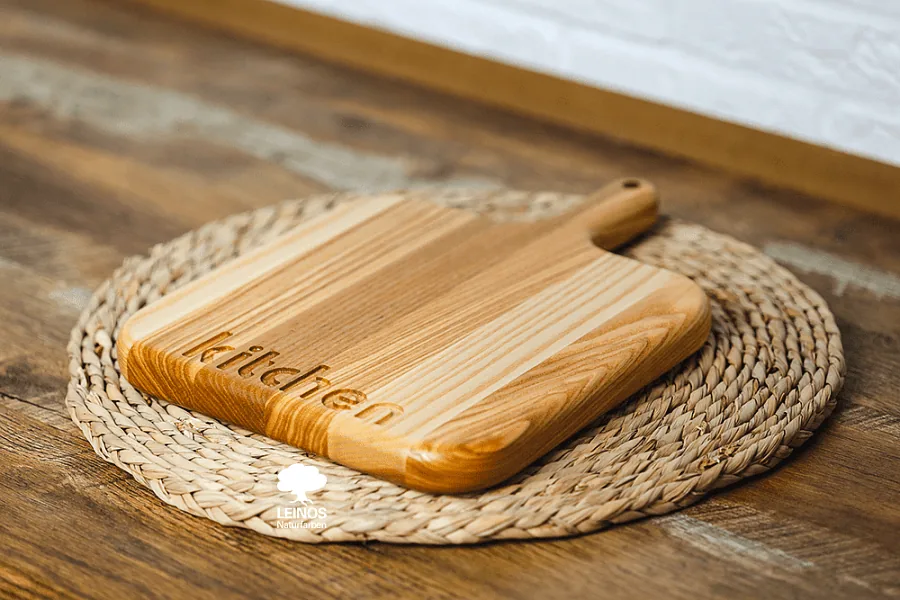
This solution applies to wooden worktops, cutting boards, serving surfaces, kitchen cabinetry interiors, and other wooden elements in kitchen environments where food contact may occur.
In the wild
Common Questions
Next step
Move into the filtered catalogue, or jump back to surface choice if you're still scoping the project.
Adjacent applications
Need a Recommendation?
Four ways to reach our India team — pick the one that fits how you work.