Mineral Surfaces · Solutions

Exterior Mineral Façades

A Pondicherry French-quarter townhouse in deep saffron limewash, a Portuguese-era Goa villa with ochre-pigmented lime render, a colonial-Bombay sea-front block in cream-grey cement plaster, a contemporary Bangalore residential bungalow in warm mineral-paint envelope — Indian façades carry both heritage substrate chemistry (lime, ochre, traditional mineral pigments) and modern engineered render (cement-lime, polymer-modified plaster, WDVS/EIFS insulation panels). The architectural envelope is the building's slowest-cycling design surface: every coating decision affects 10–25 years of weather, UV, and substrate dialogue. The system documented for that reality is the LEINOS sol-silicate façade line — Mineral Plaster Primer 622, ProfiGrund Quartz Filler 610, Profi Fixative 611, ProfiSol Facade Paints 612 (fine) and 613 (coarse), UniverSil Facade Paints 614 (fine) and 615 (coarse) — assembled as a three-layer mineral envelope tested per DIN EN 1062-3 (water permeability), DIN EN ISO 7783 (sd-value, water-vapour diffusion), and BFS Merkblatt Nr. 26 (colour stability A1).

ExteriorThree-Layer System7 compatible products
  • Permanent silicate bond — silicifies into the substrate, not a peeling film
  • sd-value 0.01 m — vapour-permeable through Indian monsoon RH 85%+
  • A1 colour stability (BFS Nr. 26) — coastal UV + saffron / ochre heritage tones
  • pH ≥ 11 alkaline — natural anti-algae / anti-mould without biocide on shaded north elevations
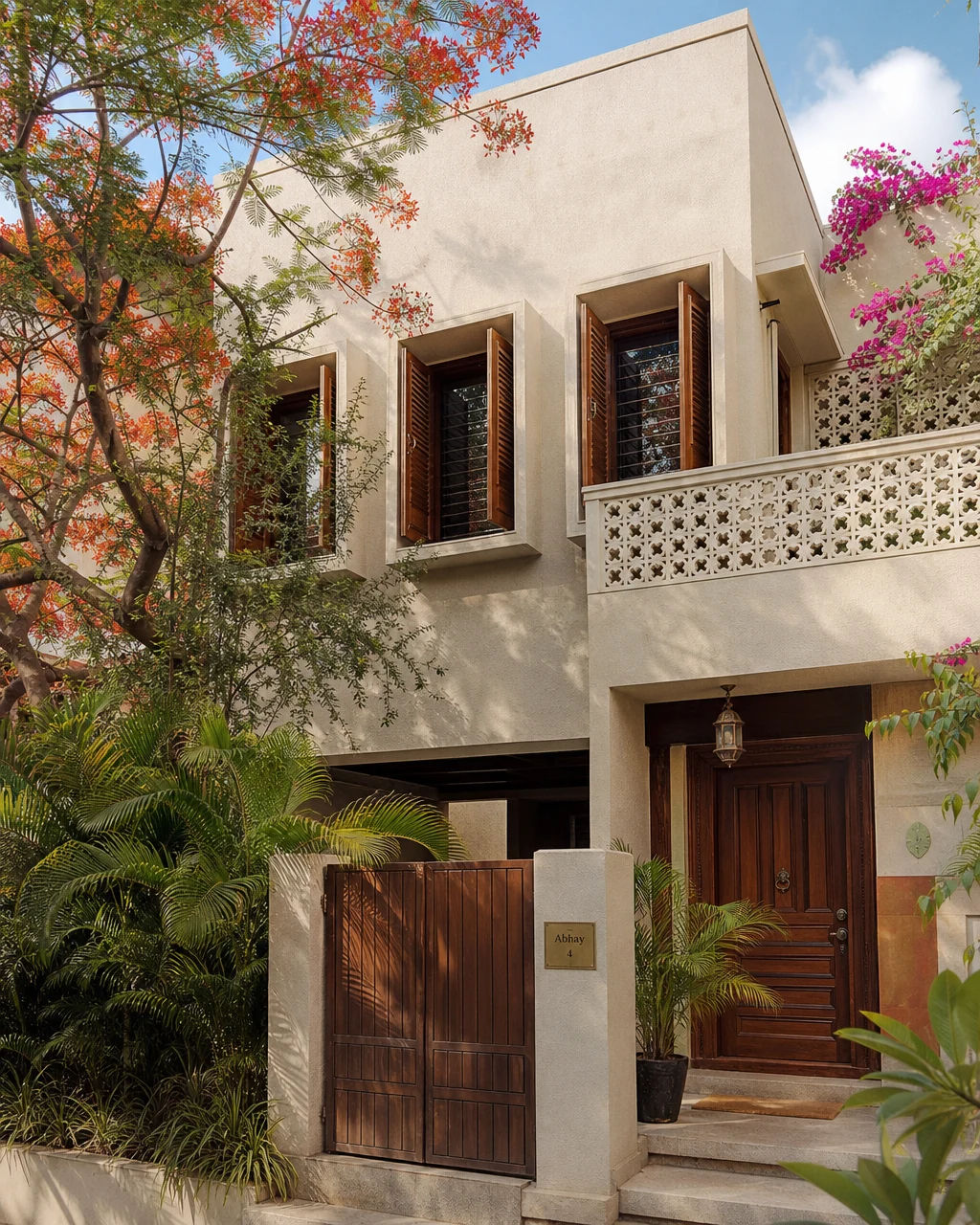
Modern Bangalore residential façade in warm cream-grey silicate mineral paint with carved teak shutters, jali-screen balcony casting fragmented light, gulmohar tree, brass nameplate

Find your application

Pick the substrate. We'll show what fits.

A contemporary Bangalore villa with warm cream-grey cement-lime render, a Mumbai high-rise residential block in tinted mineral envelope, a new-construction Pune apartment façade in soft ochre. Modern rendered façades — typically cement-lime or polymer-modified render on a 28-day cure schedule — route to the full mineral envelope: Mineral Plaster Primer 622 (suction-control on absorbent fresh render) → ProfiGrund Quartz Filler 610 (0.4 mm fibre-reinforced ground coat, crack-bridging) → ProfiSol Facade Paint 612 fine-grain or 613 coarse-textured (sol-silicate, sd-value 0.01 m, A1 colour stability). Custom mineral-pigment tinting supports architect-specified colour boards; the silicate bond carbonates over months into a permanent mineral envelope that ages by gentle chalking rather than peeling.

7 compatible products

Mineral Plaster Primer

Water-based silicate primer that evens absorbency on interior mineral walls — lime plaster, cement, clay, brick, aerated concrete, gypsum board. The prep coat under LEINOS lime, silicate, and natural mineral paints.

View product details
ProfiGrund Quartz Filler

Fibre-reinforced quartz filler primer for mineral facades — levels hairline cracks and plaster repairs up to 0.4 mm.

View product details

Profi Fixative

Professional fixative for workability control — serves as primer and binder for mineral facade systems.

View product details

ProfiSol Facade Paint Fine

Sol-silicate facade paint with mineral character — silicification-capable, water-vapour diffusible, available in 200+ colours.

View product details

System & Substrates

Three-layer mineral façade envelope. Primer 622 + ProfiGrund 610 + Sol-Silicate Topcoat (612/613 mineral or 614/615 hybrid).

For the broader exterior envelope including compound walls, boundary walls, and non-architectural exterior, see Exterior Walls. For heritage limewash chemistry on interior walls, see Interior Walls.

How This System Works

1

Primer

Mineral Plaster Primer 622 — silicate primer that controls suction on fresh modern render and creates the silicification base. Apply 28 days after render cure, never earlier. 1 coat brush or roller, dry 6 h, recoat 12 h.

Mineral Plaster Primer 622 — silicate primer for fresh cement-lime or polymer-modified render. Mandatory on new-construction substrate to control suction and prepare silicification. 1 coat, dry 6 h, recoat 12 h. Specify after 28-day render cure.

2

Base Coat

ProfiGrund Quartz Filler 610 — fibre-reinforced ground coat (0.4 mm) that equalises render texture and bridges hairline shrinkage cracks typical of new-construction substrate. Specified across the full elevation before the silicate topcoat.

ProfiGrund Quartz Filler 610 — fibre-reinforced sol-silicate ground coat (0.4 mm). Full-surface 1 coat, dry 12–16 h. Bridges new-render shrinkage cracks and equalises substrate suction before topcoat specification.

3

Top Coat

Pure sol-silicate topcoat — ProfiSol 612 fine (0.5 mm grain, default for smooth modern render) or 613 coarse (1.0 mm grain, where the architect specifies a textured tactile envelope). 2 coats, dry 12 h between, full silicification cure 14–28 days. Custom mineral-pigment tinting at factory batch.

ProfiSol Facade Paint 612 (fine, 0.5 mm) — pure sol-silicate. Default for smooth contemporary residential render. sd-value 0.01 m, A1 colour stability (BFS Nr. 26), pH ≥ 11 alkaline anti-algae/mould. 2 coats, recoat 12 h.

ProfiSol Facade Paint 613 (coarse, 1.0 mm) — same chemistry as 612 with coarser quartz aggregate. Specify where the architect wants a textured tactile envelope or where the underlying render carries visible relief that the topcoat should follow.

× 2 coats

Step by Step

How to Apply

  1. Verify 28-day render cure and substrate alkalinity (specifier-grade)

    Confirm the render substrate has cured the documented 28 days minimum before any coating specification. Measure free-alkali pH on three sample points per elevation — pH ≥ 9 confirms the silicification window is open. Visually inspect for efflorescence (white salt bloom), hairline shrinkage cracks, and any prior coating residue. Modern Bangalore villa work typically pre-schedules render and coating in separate trade packages to honour this cure window; tender language should call out the 28-day lock explicitly to prevent contractor compression.

  2. Adhesion test per Hard Constraints — three patches per elevation

    Apply a 200 × 200 mm test patch of the proposed primer + ground coat + topcoat stack on three locations per elevation (top corner, mid-elevation, base near plinth). After 48 h cure, run DIN EN ISO 2409 cross-cut with a six-tooth blade plus Tesa-peel pull-off test on each patch. Photo-document every patch against scale rule and elevation reference for the project file. Cross-cut score Gt 0–1 confirms specification readiness; Gt 2–5 routes back to substrate-repair, not coating substitution.

  3. Scaffolding moisture-shield and shade-netting protocol in place

    Specify scaffolding mesh + tarpaulin shield as a tender line item. Mesh deflects driven rain off the freshly coated elevation for the first 48 h of silicification. Sun-side elevations (south, west in most Indian latitudes) additionally require shade-netting against flash-cure under direct afternoon UV — schedule those elevations for the cool morning window only. North-elevation work proceeds first as the most forgiving exposure; coastal-site work additionally blocks salt-spray with the same mesh layer.

  4. Apply Mineral Plaster Primer 622 across the new-render elevation

    Stir 622 well — silicate primer separates between batches. Apply 1 even coat with a façade brush or short-nap mineral roller, working into corners, mortar-joint reliefs (if any), and reveal returns. Dust-dry 6 h, full recoat-ready in 12 h. Working temperature 5–30 °C, RH below 80%. The primer dries to a slightly sand-textured matte film; do not expect the gloss of an acrylic primer — the silicate bond is happening, not a film build.

  5. Apply ProfiGrund Quartz Filler 610 ground coat

    Stir 610 well — fibre-reinforced ground coats settle hard. Apply 1 even coat full-surface with façade brush or trowel-and-float (depending on architect-specified texture). The 0.4 mm grain reads as a fine-textured veil that equalises substrate suction and bridges hairline shrinkage cracks up to 0.2 mm static width. Sequence: top of elevation working down, full-bay completion before break-line, to prevent banding at scaffold-board joints. Dry 12–16 h, recoat after 24 h.

  6. Apply first coat of sol-silicate topcoat (612 fine or 613 coarse)

    Stir topcoat well — mineral pigments settle. Apply 1 even coat with façade brush or short-nap mineral roller, working corner to corner with wet-edge technique to prevent lap marks on the freshly silicifying surface. End-grain corners and reveal returns absorb more — let the silicate bond there. Recoat after 12 h dry. Sequence top-down per elevation; complete a full bay before scaffold break to keep colour batch continuous.

  7. Apply second coat of topcoat and edge inspection

    Apply the second coat the same way, wet-edge corner to corner. After the second coat, inspect every elevation in raking light morning and evening on the day after application — visible lap marks, run-off marks from drip lines, or banding at bay joints must be diagnosed and re-coated within 48 h while the silicate is still bonding. Past 48 h, a re-coat is a full new specification — the carbonated surface is already bonded.

  8. Silicification cure and 25-year envelope handover

    Surface dust-dry 4 h, handle-ready 24 h. Full silicification cure 14–28 days — the silicate ion-exchange bond completes through ambient CO₂ uptake. Do not pressure-wash, mask-tape, or apply any post-treatment within the 28-day cure window. Documented re-coat cycle: 15–25 years inland (Bangalore, Pune, Hyderabad), 10–15 years coastal (Mumbai, Goa, Chennai). The envelope ages by gentle chalking, not peeling — colour wash-down approaching design tolerance is the trigger for re-coat, not bond detachment.

System Composition

  • Substrate cure window — render must cure 28 days minimum before specification; pre-mature application traps efflorescence and lifts within one monsoon
  • Adhesion test on three sample patches per elevation (DIN EN ISO 2409 cross-cut + Tesa-peel pull-off) before tender — photo-documented for the project file
  • Mineral Plaster Primer 622 — mandatory on new-construction render to control suction and prepare silicification bond
  • ProfiGrund Quartz Filler 610 — full-surface ground coat to equalise texture and bridge hairline shrinkage cracks
  • ProfiSol Facade Paint 612 fine or 613 coarse — 2 coats sol-silicate topcoat, custom mineral-pigment tinting at factory batch for architect-specified colour boards

Why It Works

  • The 622 + 610 + 612/613 mineral envelope silicifies into the new-render substrate through ion-exchange — the binder becomes part of the wall, not a film on top. sd-value 0.01 m maintains the vapour-permeable envelope path through Indian monsoon RH 85%+, preventing trapped moisture failure documented on acrylic-elastomeric repaints of the same substrate class.
  • Custom mineral-pigment tinting at the factory batch supports the full architect-specified colour board with A1 colour stability per BFS Merkblatt Nr. 26 — saffron-yellow, ochre, oxide-red, sienna, lime-blue, copper-green, and the saturated heritage palette are all documented within the lightfast mineral-pigment range.
  • New-construction Bangalore and Pune residential sites that follow the 28-day cure + adhesion-test + moisture-shield protocol document a 20+ year re-coat cycle on inland elevations. The single most common specification failure mode is compressed render-cure window — coating at 14 days instead of 28 days traps efflorescence under the silicate and produces visible blooming within the first monsoon.
  • Mumbai high-rise residential blocks on coastal sea-front sites document a 10–15 year re-coat cycle on the south and west elevations (full salt-air UV exposure), with north elevations holding 15+ years. The mineral envelope outperforms acrylic-elastomeric on coastal Indian sites because the silicate bond carbonates with the substrate rather than sealing against the salt-spray load.

Pick the Right Build

Which build fits your surface?

Contemporary Bangalore residential bungalow (smooth cement-lime render, new construction)

Mineral Plaster Primer 622 → ProfiGrund Quartz Filler 610 → ProfiSol Facade Paint 612 fine (2 coats, custom mineral-pigment tint to architect colour board). The default modern-residential stack — smooth envelope, A1 colour stability, 20+ year inland re-coat cycle. Schedule cool-dry season Oct–Feb.

Primer 622 + ProfiGrund 610 + ProfiSol 612 fine — full mineral stack

Mumbai high-rise apartment block (coastal salt-air exposure, sea-front elevation)

Mineral Plaster Primer 622 → ProfiGrund Quartz Filler 610 → ProfiSol Facade Paint 612 fine (2 coats). Same chemistry as inland residential — the mineral envelope outperforms acrylic-elastomeric on salt-air sites. Specify scaffolding mesh + tarpaulin on every elevation; schedule north first, south/west cool morning only. 10–15 year coastal re-coat cycle.

Primer 622 + ProfiGrund 610 + ProfiSol 612 fine — coastal-spec protocol

Pune institutional new-build (architect-specified coarse-textured envelope)

Mineral Plaster Primer 622 → ProfiGrund Quartz Filler 610 → ProfiSol Facade Paint 613 coarse (2 coats). The 1.0 mm coarse grain reads as a tactile textured envelope from the street — used on institutional, civic, and design-feature residential where the architect wants the texture to register at human scale.

Primer 622 + ProfiGrund 610 + ProfiSol 613 coarse — textured envelope

Modern Chennai commercial block (sun-side west elevation, deferred to evening window)

Standard new-build stack but with afternoon shade-netting on the west elevation and evening-only application window (substrate temperature monitored with IR thermometer to stay within 5–30 °C documented range). Coastal coast-specific protocol applies. Mineral envelope holds 12–18 year re-coat cycle on this exposure.

Primer 622 + ProfiGrund 610 + ProfiSol 612 fine — sun-side deferred-window spec

What to Expect

  • Surface dust-dry 4 h after each coat, handle-ready 24 h, full silicification cure 14–28 days for the complete envelope. Do not pressure-wash or apply any post-treatment within the 28-day cure window.
  • Re-coat cycle on new-construction Indian residential: 15–25 years inland (Bangalore, Pune, Hyderabad), 10–15 years coastal (Mumbai, Goa, Chennai, Pondicherry). The envelope ages by gentle chalking, not peeling — colour wash-down is the trigger, not bond detachment.
  • The first-monsoon weathering of a freshly silicified envelope produces a slight matte-down on south and west elevations — this is the silicate bond carbonating fully, not a defect. The colour stabilises into its 20-year register from the second monsoon onward.

What to Avoid

  • Not for render that has not cured the documented 28 days minimum — pre-mature application traps efflorescence under the silicate bond and produces visible bloom within the first monsoon.
  • Not for substrates previously repainted in acrylic-elastomeric or rubberised exterior paint — full mechanical strip back to bare mineral is mandatory before specification; silicate cannot silicify through a synthetic film.
  • Not for compound walls, boundary walls, or non-architectural exterior surfaces — these route through Exterior Walls solution where the substrate decision matrix is broader and not specifier-grade architectural.
  • Not for fair-faced architectural concrete where formwork texture is the design intent — the ground-coat layer would obscure the texture; route to the Concrete Architectural Surfaces tab where ProfiGrund 610 is optional.

Scope & Limits

Where this system applies.

This solution applies to the architectural exterior envelope of buildings — the visible weathering façade plane on residential bungalows and villas, mid- and high-rise apartment blocks, commercial buildings, institutional buildings, and heritage-restoration projects under preservation-grade specification. Substrates covered: lime-render and lime-mortar heritage façades, cement-lime render, cement plaster, polymer-modified render, fair-faced and form-cast concrete, dressed masonry (brick, dressed stone, concrete block), and WDVS/EIFS thermal insulation composite systems with mineral or synthetic outer render.

Requirements

  • Before compatible products can be specified, the following must be confirmed by site survey or architect-led inspection:
  • Substrate alkalinity within the silicate-bonding window — fresh lime, lime-cement, or cement render must carry a free alkali pH ≥ 9 to permit silicification; fully carbonated heritage substrates (pH 7–8) require adhesion verification per the next bullet
  • Adhesion test on every substrate before specification — DIN-style cross-cut (EN ISO 2409) plus Tesa-peel pull-off on three sample patches per façade elevation, photo-documented for the project file; failed cross-cut score (Gt 3–5) routes back to substrate-repair, not coating substitution
  • Scaffolding moisture-shield protocol in place — site mesh + tarpaulin to deflect driven rain off the freshly coated façade for the first 48 h; sun-side elevations require shade-netting against flash-cure under direct afternoon UV
  • Ambient conditions inside the documented window — air and substrate temperature 5–30 °C, relative humidity below 80% during application, no rain forecast within 24 h of the final coat, no work below dew-point on coastal sites
  • Surface temperature 5 °C above dew point at the moment of application — measure with an IR thermometer on the working elevation before each work session; afternoon elevations in May–June Indian summer routinely exceed the documented 30 °C ceiling and must be deferred to evening
  • Prior-coating strip protocol for any non-mineral existing finish — acrylic, alkyd, polyurethane, latex, or elastomeric repaints must be mechanically stripped to bare mineral substrate; silicate cannot silicify through a synthetic film, and a partial-strip will telegraph through the new envelope within one monsoon

Not compatible with

  • This system does not apply to:
  • Façades previously repainted in acrylic-elastomeric or rubberised exterior paint — the synthetic film blocks silicification entirely; the documented response is full mechanical strip back to bare mineral, not over-coating
  • Gypsum-based exterior render or Plaster-of-Paris (PoP) ornamental façade elements — gypsum is incompatible with silicate chemistry on an exterior plane (gypsum + lime water = ettringite expansion); these elements require either replacement with lime-based ornament or a separate non-silicate system outside the LEINOS façade line
  • Polyurethane-sealed concrete or PU-coated cast-in-place panels — PU films are non-absorbent; mineral coatings cannot bond to a sealed PU surface and will delaminate within months. Strip the PU mechanically or chemically before specification
  • Cement render or concrete cast less than 28 days before coating — fresh cementitious substrate carries excess alkali and crystalline water; coating before 28-day cure traps efflorescence under the film and causes lift within one monsoon cycle

Common Questions

Frequently Asked

Next step

Ready to see the 7 compatible products?

Move into the filtered catalogue, or jump back to surface choice if you're still scoping the project.

Need a Recommendation?

Talk to

Four ways to reach our India team — pick the one that fits how you work.